
Border Wall Threatens Sacred Mountain
Air Date: Week of June 19, 2026
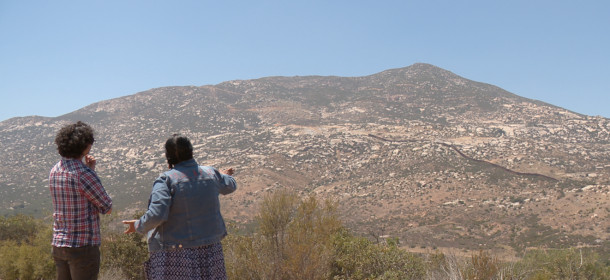
KPBS reporter Gustavo Solis (left) looks out over Tecate Peak’s new border wall construction with Norma Meza Calles (right), a Kumeyaay leader who lives in Baja California. Tecate Peak is considered sacred to the Kumeyaay community. (Photo: Carlos Castillo / KPBS)
As part of its hard line on immigration, the Trump administration is building out new sections of border barriers, and one of the sections recently under construction runs across a small Southern California mountain just east of San Diego called Tecate Peak. KPBS reporter Gustavo Solis says construction crews are destroying parts of a mountain that’s sacred to the Kumeyaay people of California and Baja California.
Transcript
DOERING: It’s Living on Earth, I’m Jenni Doering.
BELTRAN: And I’m Paloma Beltran.
As part of its hard line on immigration, the Trump administration is building out new sections of border barriers, and one of the sections recently under construction runs across a small Southern California mountain just east of San Diego called Tecate Peak.
KPBS reporter Gustavo Solis says construction crews are destroying parts of a mountain that’s sacred to the Kumeyaay people of California and Baja California.
SOLIS: The Kumeyaay name for Tecate Peak is Kuchamaa Mountain. And to them, the area along the U.S.-Mexico border near the Mexican city of Tecate is a sacred place.
Norma Meza Calles has spent her entire life around the mountain. She can tell you which plans cure an upset stomach and which ones help you fall asleep.
MEZA: La montaña es como un psicologo para nosotros.
SOLIS: Meza says the mountain is like a therapist for the Kumeyaay. People hike up the mountain, sit on the smooth white boulders, and mediate. As a little girl, she remembers seeing grown-ups spend multiple days in silent contemplation up on that mountain. Usually after a difficult divorce or a death in the family.
MEZA: Cuando se le moría uno, un divorsio, su familia, enfermo…
SOLIS: But some of those sacred stones – boulders that have been on that mountain for more than 100 million years – are gone. Pulverized, to make way for a new section of President Donald Trump’s border wall.
MEZA: Es muy importante la montana que estan, estan destryuendo.

Above, stone is demolished to make way for a border wall expansion near Tecate. (Photo: Carlos Castillo / KPBS)
SOLIS: It’s being destroyed before our eyes, Meza says. Kuchamaa Mountain is technically protected in the National Register of Historic Places. Yet, this construction project was approved without a formal environmental review, which is normally required by the National Environmental Policy Act. Richard Kiy is president of the Institute of The Americas.
KIY: In recent years what has happened is that the Department of Homeland Security has been able to secure successfully through legal means waivers on some of these border projects and congress has actually authorized multi-year funding for the border fence which has allowed some of these projects to be fast-tracked.
SOLIS: Kiy worked for the EPA on cross-border affairs during the Clinton administration. He says the stones on Kuchamaa Mountain may have been saved, had there been a typical review.
KIY: That would’ve allowed for considerations related to the cultural significance of Mount Kuchumaa.
SOLIS: He understands why the Trump administration waived these requirements. The process can take years, and derail projects. For example, it took 10 years to complete a review of the CBX airport border crossing in Otay Mesa. But Kiy says skipping these reviews altogether is a missed opportunity to potentially find eco-friendly alternatives.
KIY: In the 21st century I think there are ways to explore technology solutions so that we can have a secure border but at the same time address some of the biodiversity concerns and cultural heritage concerns.
SOLIS: Like Norma Meza, Demian Vega grew up near the mountain. Vega works for the Rancho La Puerta Foundation – an organization that helped create a conservation easement on the Mexican side of the border, and part of that work involves teaching local children about the mountain.

Norma Meza Calles is a Kumeyaay trail guide, interpreter and cultural ambassador. (Photo: Carlos Castillo / KPBS)
VEGA: That’s the things that the kids learned here in the trail. And they also learned to meditate along with the walk. But all of those activities have stopped because how can they meditate with the noises that we have and the construction that we have in front of their eyes.
SOLIS: The foundation worked with multiple organizations in Mexico to conduct their own environmental feasibility study. They looked at everything from wildlife, natural habitats, vegetation, cultural sites and even the risk of mudslides. Part of what makes this construction project so heartbreaking for the people of Tecate is that they thought they’d done enough to protect it. Vega says that, in the early 2000s, the Kumeyaay people and local conservationists worked hard with their counterparts in the U.S. to secure environmental protections on both sides of the border.
VEGA: Through an MOU with the Bureau of Land Management, the BLM, and with the Forestry Department, we also try to convince them to protect the land and we agree, both of the sides, both of the nations – so all of the mountain is protected in terms of nature and biodiversity.
SOLIS: Baja California’s Secretary of Culture has asked the United States to stop detonating explosives on the mountain. And Mexico President Claudia Sheinbaum said in a press conference in April that her administration is looking into the matter.
Meanwhile in Tecate, Meza does not expect construction to stop. She respects U.S. sovereignty and its right to defend their border. But views this episode as one more indignity for her people to overcome.
MEZA: Desde quando hemos sido pisotiados, hemos sido descriminados, hemos sido pues – y hemos resistido – y Tambien la montana esta resitiendo
SOLIS: She says the Kumeyaay in Baja, California have been stepped on and discriminated against most of her life. And through it all, they’ve always resisted. And the mountain? The mountain will resist too.
BELTRAN: Gustavo Solis reported this story for KPBS.
Links
Living on Earth wants to hear from you!
Living on Earth
62 Calef Highway, Suite 212
Lee, NH 03861
Telephone: 617-287-4121
E-mail: comments@loe.org
Newsletter [Click here]
Donate to Living on Earth!
Living on Earth is an independent media program and relies entirely on contributions from listeners and institutions supporting public service. Please donate now to preserve an independent environmental voice.
NewsletterLiving on Earth offers a weekly delivery of the show's rundown to your mailbox. Sign up for our newsletter today!
 Sailors For The Sea: Be the change you want to sea.
 The Grantham Foundation for the Protection of the Environment: Committed to protecting and improving the health of the global environment.
 Contribute to Living on Earth and receive, as our gift to you, an archival print of one of Mark Seth Lender's extraordinary wildlife photographs. Follow the link to see Mark's current collection of photographs.
 Buy a signed copy of Mark Seth Lender's book Smeagull the Seagull & support Living on Earth
© Copyright World Media Foundation. All Rights Reserved
Home | Contact | RSS | Donate | Newsletter