

Stormy Weather for Climate Science
Air Date: Week of February 20, 2026
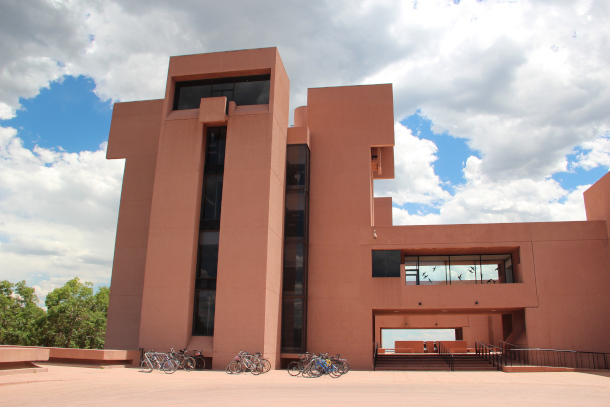
The National Center for Atmospheric Research in Boulder, Colorado. (Photo: Thomson M, Wikimedia Commons, CC BY 3.0)
The Trump administration has declared scientists at places like the National Center for Atmospheric Research are promoting ‘climate hysteria’ by overstating the risks to public health and safety, so it’s moving to cut off funds for NCAR. Former TV weatherman Alan Sealls, president of the American Meteorological Society, joins Host Steve Curwood to discuss the important climate and weather modeling NCAR does and how the loss of funding could impact this research.
Transcript
DOERING: It’s Living on Earth, I’m Jenni Doering.
CURWOOD: And I’m Steve Curwood.
The Trump White House has declared scientists at places like the National Center for Atmospheric Research or NCAR are promoting climate hysteria by overstating the risks to public health and safety. So, citing what he calls “climate alarmism,” White House Budget director Russ Vought says he has ordered the National Science Foundation to cut off funds for NCAR, which is based in Boulder, Colorado. Alan Sealls is a former TV weatherman who teaches meteorology at the University of South Alabama and serves as president of the American Meteorological Society. Welcome to Living on Earth, Alan!
SEALLS: Thank you. Happy to be here.
CURWOOD: So many Americans, I dare say that most, aren't familiar with the National Center for Atmospheric Research, or NCAR, yet it plays a central role in weather and climate research in the United States and around the world, indeed. Describe for us what exactly NCAR does.
SEALLS: Yeah. So NCAR, National Center for Atmospheric Research, what it does is in the name. It is the center for our nation's research into the atmospheric science. A lot of folks right now, if they look at their weather app on their phone, the computer model that they're seeing on the phone either directly came from NCAR or it was a base model that's public domain, that was built upon by private companies to improve it and make it more detailed and more local. So in the most basic sense for meteorologists, NCAR has come up with all sorts of incredible assets that we use to model weather, predict the weather. They've come up with tools that the hurricane hunters use when they're in a hurricane to drop into the storm and get more detailed measurements, which statistically improves the forecast. NCAR has come up with methods to reduce aircraft turbulence, which not only makes it more comfortable for the passengers, but it makes it more cost effective for the airlines to avoid the turbulence. It extends the life of, literally, the airplanes. And NCAR definitely is known for climate research. What NCAR has done over the decades is allowed climate scientists to figure out that, yes, fossil fuels create carbon dioxide, which, yes, does create sort of a barrier to allow heat to be trapped in the earth, which is what we call climate change. So things like that, that's what NCAR helps us better understand. And we're not done yet. It is a nonstop process to gain more knowledge and share that knowledge with the world.
CURWOOD: NCAR is not a government agency exactly. What is it?
SEALLS: So it's really interesting. NCAR was started by the National Science Foundation, which is a government agency. And that started about 1950. Ten years later, NCAR was put together as a consortium of universities that said, we can't afford to have our own computers, but we need them to do research. We can't afford to have our own aircraft, but we need aircraft to do our own research. So NCAR is sort of a central repository of not only data, but resources, equipment, brain power that universities can tap into to do their research.
The National Science Foundation will be breaking up the National Center for Atmospheric Research (NCAR) in Boulder, Colorado. This facility is one of the largest sources of climate alarmism in the country. A comprehensive review is underway & any vital activities such as weather…
— Russ Vought (@russvought) December 17, 2025
CURWOOD: So the White House has suggested that NCAR's responsibilities could be simply relocated to other organizations. At the same time, though, the Trump administration has significantly reduced funding for several science agencies, including the National Science Foundation itself. So given these cuts, to what extent do you think other institutions have the capacity to take on NCAR's work?
SEALLS: So I think the duties that NCAR has could be moved around, and still, the overall product would be the same. But the question is, why? Why would you take something, in my opinion, that's working really well, and take it apart? And I will add that recently, the budgets for NASA, NOAA, USGS, other government agencies, those budgets were finalized in a bill which, the cuts were nowhere near as severe as the White House Office of Management and Budget originally intended. They were not too far off the mark from last year's budget. But the problem is, NCAR is not listed in the budget, which means, in a sense, it already on paper, has disappeared. So now we're at the crossroads of, what do we do? How do we rebuild or reorganize? I don't think anyone is sure the best way to do it. And that brings us to where we are at this point, which is the National Science Foundation put out a notice called the DCL, Dear Colleague Letter, and the Dear Colleague Letter goes out to the entire industry and the world, and it says, what's your input? What do you think we can do to move what was NCAR in a different direction?
CURWOOD: So you are president of the American Meteorological Society, and you had an annual meeting at the end of January. So what's the overall mood, the sentiment within your colleagues regarding these proposed changes to the National Center for Atmospheric Research?
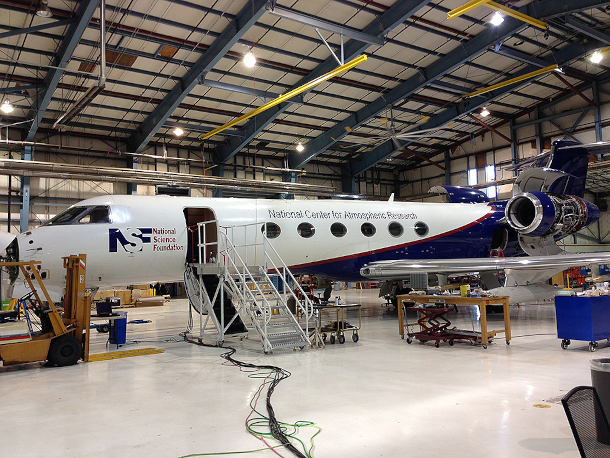
NCAR’s two research aircraft are among the world’s most advanced tools for gathering atmospheric data. Sealls worries that private industry may take over these capabilities, resulting in a less equitable spread of data for all. (Photo: National Science Foundation, Wikimedia Commons, Public Domain)
SEALLS: It was a mixed feeling. We actually had a town hall session specific to what was going on at NCAR, and it was a packed house, hundreds of people, and almost all those people in one form or another, had either worked with NCAR, at NCAR, or received the benefit of NCAR. And as you would imagine, people were, they weren't surprised, but no one was happy about what was going on. And it was really more questions about, how do we go forward, rather than people saying, oh, we need to hold on to what was. Because it's pretty obvious right now that NCAR will not be allowed to be what it was. So within the American Meteorological Society, we are trying to get all of our members to give us input, so that we can give input to the National Science Foundation. But a large part of our membership is private industry. So for example, NCAR maintains two research aircraft. It doesn't specify, what should we do with this aircraft or these aircraft, but the letter does say, what do you think we can do to replace that capability? Private industry could say, hey, we've got aircraft. We can do this research. Some of that I find a little bit odd, because private industry is all about competition with other businesses, whereas NCAR is about collaboration and sharing on on an equal level. And that is one of the strengths of a government funded agency, is that everybody benefits equally.
CURWOOD: This isn't the first pushback by the federal government against climate and meteorological research. Some folks have said that we're behind in building weather satellites that can help us observe Earth's systems. What's your view of that?
SEALLS: So in weather technology, there is always research where we say, here's the latest, greatest tool that we need to replace our current tools. And that requires funding, government funding. It requires research. And the latest round of satellite technology, there are some sensors that could go on the satellite that right now, the government is not funding for them to go there. It's available. The hardware is there. The technology is there. But the government is saying, well, we don't think that part is important. Sometimes, because that part happens to be associated with climate which right now is associated with something negative, but that's really short-sighted.
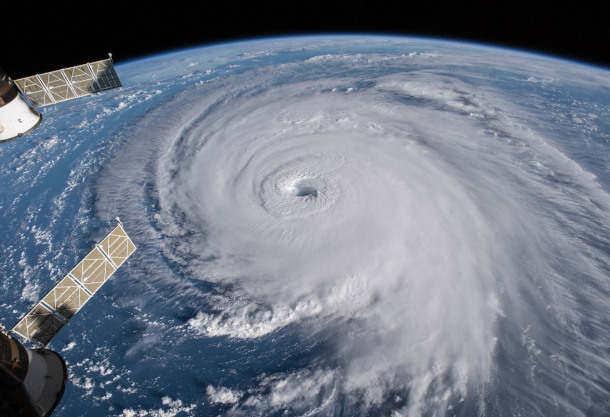
Sealls emphasizes the importance of weather satellites for forecasting and tracking storms, adding that sustained government funding is required to update and maintain this technology. (Photo: NASA/Goddard Space Flight Center, Wikimedia Commons, CC BY 2.0)
CURWOOD: So what are the risks that we face when it comes to weather forecasting and disaster preparedness without a fully functioning NCAR?
SEALLS: I'll tell you what it's not first, because sometimes people jump to the most gloom and doom projection. It's not going to say that tomorrow's weather forecast is going to be bad or less accurate, but what it does say is two or three years from now, the forecast may not be any more accurate than it is this year. NCAR has allowed steady progress in forecasting weather. And it means that if we lose NCAR and its capabilities, we will start lagging behind other countries as a nation. And again, the capabilities go into our communication and electrical power. When we have our big storms, those are the two things that we often lose. So it's about being able to better predict, which means better prepare and be less vulnerable to the extremes of weather.
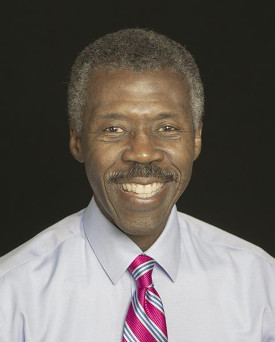
Alan Sealls is a broadcast meteorologist, author, and professor of weather broadcasting at the University of South Alabama. He’s also the current president of the American Meteorological Society. (Photo: Courtesy of Alan Sealls)
CURWOOD: So let's look ahead now. What do you expect the next few months to hold for NCAR as an organization, do you think?
SEALLS: Uncertainty, unfortunately. One of the points that I picked up at our American Meteorological Society conference, when I talked to folks in the private weather industry, they said, we can't make decisions because there's no certainty, and that means they can't invest. Another company that makes radars, for example, says the parts, we have to pay more because of the tariffs. So the uncertainty right now feeds into the bigger picture of our communities. The Dear Colleague Letter that we talked about, coming from the National Science Foundation, in theory, it should help the National Science Foundation say, oh, we have found these really good solutions to what we can do after NCAR is gone. But we don't know that they're going to follow that. We would hope that they do, but we don't know. So unfortunately, uncertainty.
CURWOOD: Alan Sealls is a broadcast meteorologist, author and professor of weather broadcasting at the University of South Alabama. Thank you so much for taking the time with us today.
SEALLS: Thank you.
Links
About the National Center for Atmospheric Research (NCAR)
Read the National Science Foundation’s Dear Colleague Letter
Living on Earth wants to hear from you!
Living on Earth
62 Calef Highway, Suite 212
Lee, NH 03861
Telephone: 617-287-4121
E-mail: comments@loe.org
Newsletter [Click here]
Donate to Living on Earth!
Living on Earth is an independent media program and relies entirely on contributions from listeners and institutions supporting public service. Please donate now to preserve an independent environmental voice.
NewsletterLiving on Earth offers a weekly delivery of the show's rundown to your mailbox. Sign up for our newsletter today!
 Sailors For The Sea: Be the change you want to sea.
 The Grantham Foundation for the Protection of the Environment: Committed to protecting and improving the health of the global environment.
 Contribute to Living on Earth and receive, as our gift to you, an archival print of one of Mark Seth Lender's extraordinary wildlife photographs. Follow the link to see Mark's current collection of photographs.
 Buy a signed copy of Mark Seth Lender's book Smeagull the Seagull & support Living on Earth
© Copyright World Media Foundation. All Rights Reserved
Home | Contact | RSS | Donate | Newsletter