

Willing to End Fossil Fuels
Air Date: Week of May 8, 2026
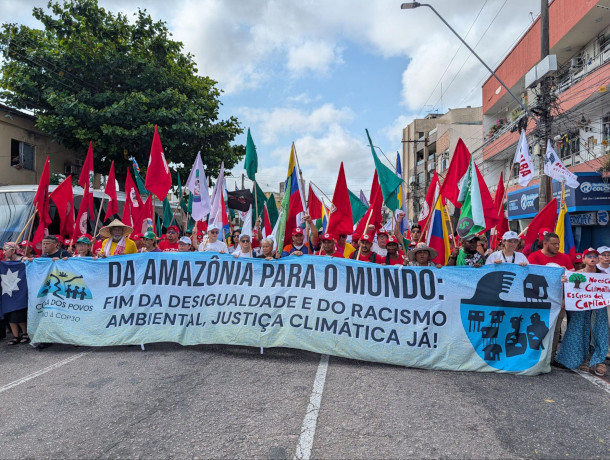
Pictured above is a collection of civil society groups, Indigenous representatives, and activists protesting at COP30 in Belém, Brazil (November 2025). The demonstration demanded stronger action against climate change, the protection of the Amazon, and a faster phase-out of fossil fuels. (Photo: Xuthoria, Wikimedia Commons, CC BY 2.0)
The first gathering of a new international “coalition of the willing” to transition away from fossil fuels recently took place in Colombia. It’s a separate event from the UN COP climate negotiations and was born in part out of frustration over fossil fuel friendly nations like the US, Russia, China, and Saudi Arabia stalling the COP process. Rodrigo Estrada, Senior Climate Advisor at Greenpeace International, was there and joins Host Aynsley O’Neill to share the takeaways and next steps.
Transcript
DOERING: From PRX and the Jennifer and Ted Stanley Studios at the University of Massachusetts Boston, this is Living on Earth, I’m Jenni Doering.
O’NEILL: And I’m Aynsley O’Neill.
The first gathering of a new international “coalition of the willing” to transition away from fossil fuels took place in Santa Marta, Colombia at the end of April. It’s a separate event from the UN COP climate negotiations and it was born in part out of frustration over fossil fuel-friendly nations stalling the COP process. So, for this conference, nations seen as spoilers, like the United States, Russia, China, India, and Saudi Arabia were specifically not invited. Jointly convened by Colombia and the Netherlands, this event brought together 57 countries and the European Union, representing roughly 30% of global energy demand. Also present were civil society organizations and representatives of indigenous peoples. The conference was aimed at accelerating political momentum for a just energy transition and closing the gap between discussions and concrete action when it comes to international climate negotiations. Rodrigo Estrada is a Senior Climate Advisor at Greenpeace International who was there in Santa Marta. Rodrigo, welcome to Living on Earth!
The United States, China, Russia, India, and many other countries were not invited to the coalition event, given their history of inhibiting climate action at the international level. The interactive map above shows the last 60 years of global fossil fuel usage, measured in terawatt-hours. (Image: Our World In Data, ourworldindata.org, CC BY 4.0)
ESTRADA: Thank you so much for having me. It's really a pleasure, and I'm glad that I'm able to share a little bit more with you of what was happening down there in Colombia.
O'NEILL: So tell us what the energy was like there.
ESTRADA: Well, it was actually fantastic, because being a coalition of like-minded states and like-minded people, it was really a breath of fresh air in terms of what it means to be in those spaces. You having international negotiations and you know, when it comes to politics, there's always something that you might not necessarily agree with, or you don't see eye to eye with, and in this particular case, because everyone was there with the mission of kicking off a serious conversation about how to transition away from fossil fuels and many find that hard to believe, but it had never actually happened at that level, so the spirits in there were high. People were just like, really hopeful. Our conclusion was that it was really that breath of fresh air, like, you know, it really felt that we were heading somewhere.
O'NEILL: And now this conference went on for, you know, a number of days. For you Rodrigo, what were the main takeaways from this?
ESTRADA: So to me, the first one was the establishment of this advisory scientific panel on the transition, which is meant to be this advisory body that it's going to provide states with feedback and ideas on how to actually make these work. And this is also thought to be a complement to what the International Panel on Climate Change is up to. They look into the modeling of weather and climate impacts and where things are headed emissions-wise, whereas other panel would also be looking into, what are the economic imperatives, what are the social impacts, what needs to happen from a biodiversity perspective, and so that is really great, because it signifies that we're really looking at a transformation on how this is being approached. It's not that we're, you know, like unplugging fossil fuels to plug in something else, but rather that we are getting into these different way of doing things all together for energy, transportation and other systems.
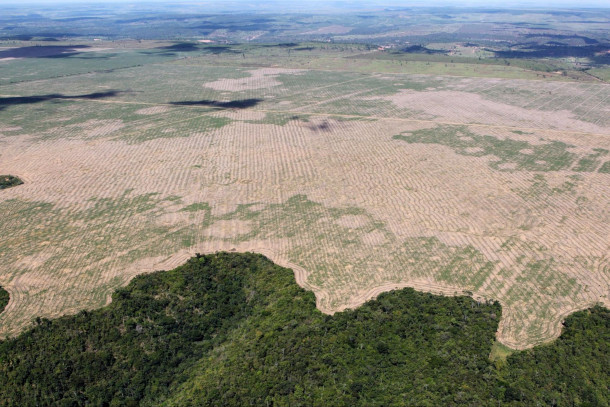
The Amazon rain forest pictured above absorbs one-fourth of the CO2 absorbed by all the land on Earth but it is threatened by deforestation, fossil fuel extraction and oil spills all of which endangers indigenous land and biodiversity. (Photo: Felipe Werneck, Ibama, Wikimedia Commons, CC BY 2.0)
O'NEILL: And now I do feel like the conference is sort of taking place at this very notable time in global history and conflict, because the US-Israel joint war against Iran has resulted in elevated oil and gas prices. It's really brought to the forefront just how dangerous it is for our society, our global society, to be so reliant on fossil fuels. What was said about this war during the Santa Marta conference? To what extent did this discussion about energy motivate or push forward this conference?
ESTRADA: There's a phrase that I really like to use in this case, which is, while we're talking about phasing out fossil fuels, that means also that we're trying to phase out the inherent instability and conflict that comes with the limited resources and scarce resources that fossil fuels represent, and we're actually phasing in renewables and the inherent stability that they can bring, because it's a very different way in which they are distributed. Every region of the world has different access to different resources, so it's a more distributed and diverse approach. And that's from the Greenpeace side of things, how we were approaching it, like we really see how this conflict and instability, not just on what's happening right now in Iran and Lebanon, but elsewhere, there are many other places where we see these conflicts playing out, where there is that underlying element of fossil fuels That's like in the back there always, you know, Ukraine, Yemen, you name it, it's really there. And so what was actually quite again, refreshing, just going back to what I was saying earlier, is that in the conversations with the government, in their speeches, in the working groups, they were really bringing that to the fore. They were really thinking on this is a moment in which we sort of get to decide which road we take. Do we continue on the same pathway of fossil fuels, extraction, exploitation, misery and war, or do we take another pathway which is on a more stable, more peaceful, more diverse scenario, that it's actually within reach, that that was another really refreshing element of it to really understand and recognize, across the board, that it is reachable. It's not some ideal vision that we're somehow miraculously waiting for. It's there.
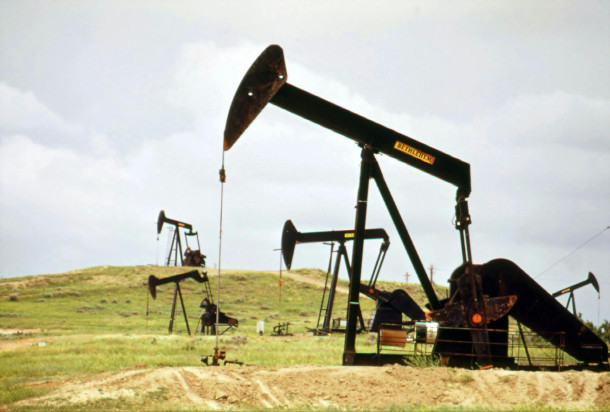
Pictured above are oil wells near Teapot Dome, Wyoming. The United States is the world's largest oil producer and it was one of the countries excluded from the First International Conference for the Transition Beyond Fossil Fuels, allegedly due to its tendency to obstruct progress on phasing out fossil fuels during previous international climate summits. Other excluded countries were Russia, China, India, and Saudi Arabia. (Photo: Boyd Norton, Documerica, Unsplash)
O'NEILL: And now there are several emerging economies that are in sort of a tricky place here. They're trying to push progressive policies on climate and environment, but they themselves are dependent on fossil fuels. Colombia, the host country, is one such example. What were some of the concerns that Colombia and these other countries might have expressed during this conference?
ESTRADA: That's a great question, because it was very patent, first of all, that there was a very strong vocal segment of the participants that were coming from the so-called "Global South", these developing economies, or these places that still face strong or very complicated issues, with poverty, with hunger, these social elements and where this idea of development has somehow been tied to fossil fuels. And what were they saying? Well, we have realized that this is not necessarily what we think it is, right? We have enough proof to show that this is not where things are supposed to be happening. So then, what is it that we're actually supposed to do? And that's where the conversations became really, really interesting for me, because it was suddenly, okay, how are we going to break free from the situation that's holding us back? And that was touching on multiple elements, you know? On the financial side, they were talking about debt and how that sort of keeps them on the same wheel of you know, we have to exploit our natural resources and allow for more extraction so that we can repay these debt that, you know, it's never ending, type of thing.
O'NEILL: And I mean, on the complete opposite end, there are also a number of developed economies that were at the conference as well. I think the European Union, the United Kingdom, Australia, Canada, to name a few. What was their role in these talks on so much of this opposite end?
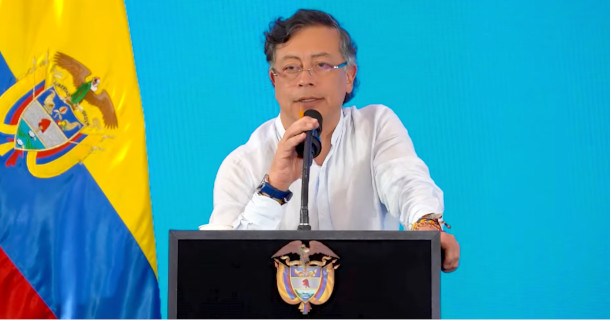
Pictured above is Colombian President Gustavo Petro, delivering a speech at the First International Conference for the Transition Beyond Fossil Fuels event. Colombia and the Netherlands co-hosted the conference. (Photo: Screenshot Youtube Presidencia de la Republica Colombia)
ESTRADA: It was quite interesting as well to see what they were up to because, you know, one of the co-hosts was the Netherlands, right? And it's a country that has this gigantic oil company, Shell. So all of them, France was in there as well, and so they were mostly on the side of also trying to figure out what they should do because even for them, there was this conversation of, what do we really need to do here, and how are we supposed to approach this, because they are also looking into a transition of their own systems. And of course, for them, because of the easy access to finance, etc., technology as well, you know, skills, etc., they sort of have it easier but that doesn't mean that it's happening. So one of the positive surprises, I would say, of the conference was that when you know France, the French government showed up, they actually brought forward a roadmap on how they are planning to make the transition in France. And of course, there are things in that roadmap that need to be looked at with a finer tooth comb to make sure that they actually meet the level of ambition that a developed country like France has to commit with. So it's, I think, really important that all of us find solutions. It's going to look different in different regions. And then there is that other element of international solidarity and support, because there are countries that do not have access to the resources, have not benefited as much, even if they are the origin of these resources.
O'NEILL: So I mean, the road is open from here, what are the next steps to sort of keep up any momentum that this conference is generating?
ESTRADA: Well, I think that the wonderful thing about it is that there are multiple parallel things happening. So first, really connected to this coalition of like-minded states. They agreed to have a second conference that's going to be co-hosted by Tuvalu and Ireland by the end of April in 2027, so that's one clear way forward in which, in the meantime, countries of the coalition are expected to work in their national roadmaps, again, just to show how they are actually going to do it. But at the same time, because, you know, the Brazilian Presidency of the UN climate talks was actually there, very active, they are going to bring back to the UNFCCC process, which is a UN climate convention, to have these conversations in the fora that correspond to that. So that is going to be, you know, the subsidiary bodies conversation that it's going to happen in Bonn in June, and then at the actual Conference of the Parties that it's going to take place in Türkiye by the end of the year this year. And then we also have this wonderful advisory panel, the scientific advisory panel, which is going to kick off and start working on providing those insights that they need.
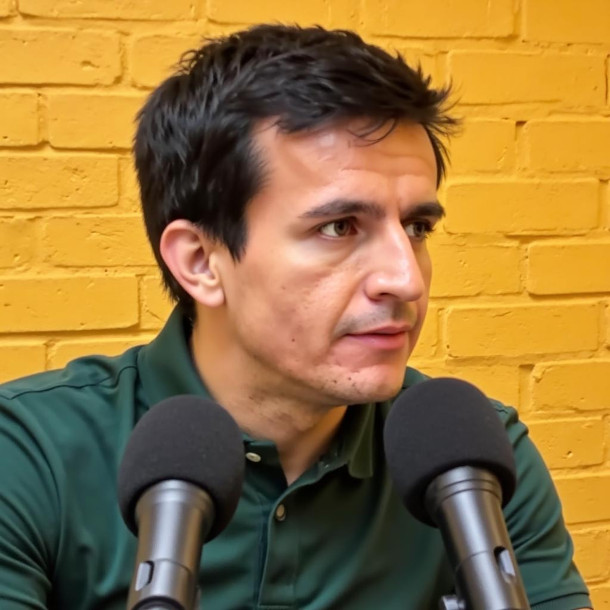
Rodrigo Estrada is a Senior Climate Advisor at Greenpeace International. (Photo: Courtesy of Greenpeace)
O'NEILL: Rodrigo, what would you say gives you hope about this “coalition of the willing”, this conference and as I said, the road that's open ahead?
ESTRADA: Well, I was just having this exact conversation a few hours ago today with my colleagues, and one of the reflections that we had is like, we are seeing things that we had only hoped for a few months ago. So this is really something that is really bringing a different energy, a different vibe, a different way of working. Of course, we still need to see what results come out of it. Like I am dying to see the roadmaps that different countries are going to bring forward. I was just mentioning that France already presented theirs. So I'm really, you know, hopeful that these things are going to pick up. I'm also really looking forward to see what the scientific advisory panel comes up with, and the fact that these spaces and these conversations are going to continue, that's also something that gives me a lot of hope, because that means that governments and people saw value in them. And it was not just an exercise of, you know, goodwill and come together and shake everyone's hands and then go back home and do nothing. It was more of like, let's come together again, let's make sure that we follow through with this. So that's what gives me hope.
O'NEILL: Rodrigo Estrada is a senior climate advisor at Greenpeace International. Rodrigo, thank you so much for joining us today.
ESTRADA: Thank you so much to you and to your audience, and I hope that we talk soon again.
Links
The Guardian | “Could Santa Marta Climate Talks Mark Ground Zero in Push to Ditch Fossil Fuels?”
Living on Earth wants to hear from you!
Living on Earth
62 Calef Highway, Suite 212
Lee, NH 03861
Telephone: 617-287-4121
E-mail: comments@loe.org
Newsletter [Click here]
Donate to Living on Earth!
Living on Earth is an independent media program and relies entirely on contributions from listeners and institutions supporting public service. Please donate now to preserve an independent environmental voice.
NewsletterLiving on Earth offers a weekly delivery of the show's rundown to your mailbox. Sign up for our newsletter today!
 Sailors For The Sea: Be the change you want to sea.
 The Grantham Foundation for the Protection of the Environment: Committed to protecting and improving the health of the global environment.
 Contribute to Living on Earth and receive, as our gift to you, an archival print of one of Mark Seth Lender's extraordinary wildlife photographs. Follow the link to see Mark's current collection of photographs.
 Buy a signed copy of Mark Seth Lender's book Smeagull the Seagull & support Living on Earth
© Copyright World Media Foundation. All Rights Reserved
Home | Contact | RSS | Donate | Newsletter