

White House Accuses NCAR of "Climate Alarmism"
Air Date: Week of May 15, 2026
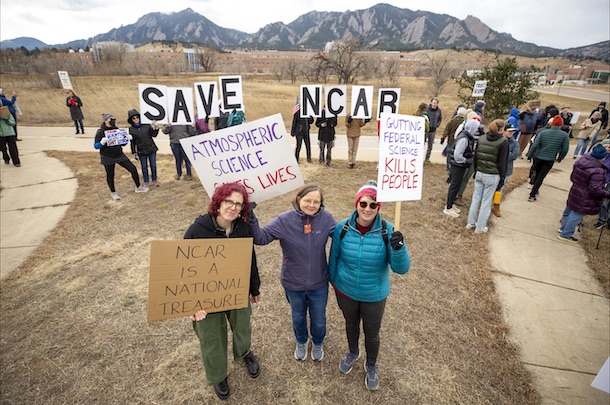
Protestors gathered in Boulder late last year to show support for NCAR in the midst of calls for its dismantling. (Photo: Kevin Beaty, Denverite)
The federally funded National Center for Atmospheric Research, or NCAR, in Boulder, Colorado has been a leading agency for decades assessing the risks and possible responses to the changing climate. But in November, the Trump administration declared it was dismantling NCAR, citing its contribution to what the administration calls “climate alarmism.” University of Colorado - Boulder Professor Waleed Abdalati talks with Host Steve Curwood about the role of NCAR and why its parent organization has filed a lawsuit alleging a “campaign of retaliation against the State of Colorado.”
Transcript
CURWOOD: It’s Living on Earth, I’m Steve Curwood.
O’NEILL: And I’m Aynsley O’Neill.
When word came of the current Hantavirus outbreak on a cruise ship, there were no rapid response investigators dispatched by the CDC, no CDC news conferences and no health alerts quickly sent to doctors and the health care system. That’s because when President Trump came into office for a second time, he shredded the workforce of the US Centers for Disease Control and Prevention, and the firings included all of the full-time staff devoted to public health concerns related to cruise ships. Ostensibly, the moves were intended to slim the federal budget, but some saw them as retribution against the CDC, punishing officials, including Dr. Anthony Fauci, who had confronted Trump’s dubious science and delayed Covid-19 pandemic response. And the CDC is not the only agency vital for public health that’s under fire from this administration.
CURWOOD: Yes, and understanding the growing climate emergency is also a matter of public health protection. The federally funded National Center for Atmospheric Research, or NCAR, in Boulder, Colorado has been a leading agency for decades assessing the risks and possible responses to the changing climate. But in November, the Trump administration declared it was dismantling NCAR, citing its contribution to what the administration calls “climate alarmism.” So, NCAR’s parent organization is suing the Trump government, claiming it is “waging a campaign of retaliation against the State of Colorado,” by trying to scuttle NCAR after Colorado’s governor refused to pardon an official convicted of election interference on behalf of Trump.* (see update at end of this transcript) As NCAR scientists have been muzzled, we turn now to Waleed Abdalati, a former NASA chief scientist who is now a professor at the University of Colorado, Boulder. Waleed, welcome to Living on Earth!
ABDALATI: Thanks for having me.
CURWOOD: Briefly, please describe for us what exactly the National Center for Atmospheric Research, or NCAR, does.
ABDALATI: So NCAR carries out all aspects of atmospheric research and environmental research related to weather, climates, drought, fires, basically how the earth system works, how it moves energy, what the implications are for weather and the way we live, from our day to day lives to our longer-term planning.
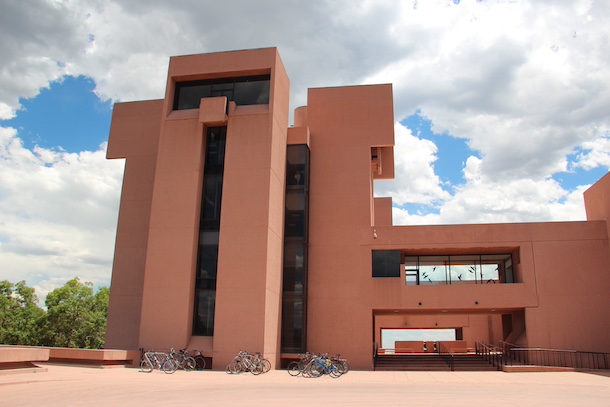
The National Center for Atmospheric Research in Boulder, Colorado. (Photo: Thomson M, Wikimedia Commons, CC BY 3.0).
CURWOOD: So the University Corporation for Atmospheric Research, the holding company, if you will, of NCAR, has filed a lawsuit arguing that dismantling NCAR would threaten national security, public safety, the economy. How well-founded are these claims, do you think?
ABDALATI: Well, I don't have the legal expertise to make judgments on the merits of the case, but as a scientist, I can certainly say that our economic and strategic interests are closely tied to how well we understand the environment and its evolution, and so efforts that compromise that do put us at risk of not being as successful as we otherwise would or could be. You know, one good example is, you know, the Arctic is changing rapidly. It's changing more rapidly than other places on Earth, and understanding the processes that govern that change will help us understand what kinds of investments we should make. What are the economic opportunities associated with an Arctic where the ice cover is shrinking? When will it shrink? What does that mean to have an exposed border that we've historically relied on being ice-covered? These are the kinds of questions that the work at NCAR and other related research can help us with and it is, in my view, detrimental to our interest to not be pursuing that understanding.
CURWOOD: So the lawsuit also suggests that the move by the Trump administration is part of the Trump administration's campaign of retaliation against the state of Colorado, and that's a direct quote from the suit. In the past year or so, the administration has blocked hundreds of millions in federal funding for states, vetoed an urgently needed water pipeline, threatened to withhold food stamp benefits from residents. So why does President Trump seem to have it out for Colorado?
ABDALATI: [LAUGH] Well, I'm not going to put myself in the mind of officials that make these kinds of decisions. What I will say is a lot of people believe that this is retaliation. Colorado in particular, being singled out because the governor of the state of Colorado has not pardoned or shown leniency to Tina Peters, the county clerk who has been accused, actually convicted of tampering with ballots in her county.* (see update at end of this transcript) And so this gets back to sort of the current administration's commitment to advancing the idea that the 2020 election was rigged, and the governor of Colorado is, I wouldn't say, pushing back on that. He's simply not agreeing to undo what a court has determined or has decided. And that, again, I'm not saying this myself, but many believe that has put the states in bad favor with the administration, and this is apparently an effort to retaliate against that.
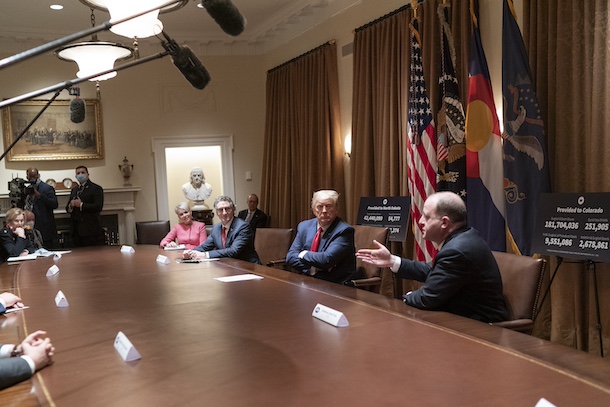
Colorado Governor Jared Polis has clashed with President Trump who wants a pardon of Tina Peters, the Mesa County clerk who was convicted in state court of tampering with 2020 election results on behalf of the president. Above, Trump (center) and Polis (right) meet at the White House. (Photo: The White House, Wikimedia Commons, Public Domain)
CURWOOD: Tina Peters was convicted for tampering with the election results in 2020 on behalf of President Trump, but of course, being a state conviction, he has no power to pardon her.
ABDALATI: That's correct.
CURWOOD: So how are others in the world of climate research and weather reacting to the prospect of NCAR getting dismantled and the lawsuit itself?
ABDALATI: I don't know how people are reacting to the lawsuit. I do think people are hopeful that they'll prevail, because the issue from the science perspective is this is a tremendous capability that at best will be compromised, at worst, would be destroyed. The administration did seem to single out NCAR's climate work and climate alarmism, as they call it. You know, one, NCAR does so much more. And two, I don't think there's alarmism by the scientists at NCAR. They do research and they report, through peer review, what they find. The fact that some of it is or can be alarming doesn't make the alarm the goal of the work. I think there's a great loss for the wrong reasons. I mean, there's no good reason for dismantling this or tearing it down, but I do think the allegations that are made are off the mark.
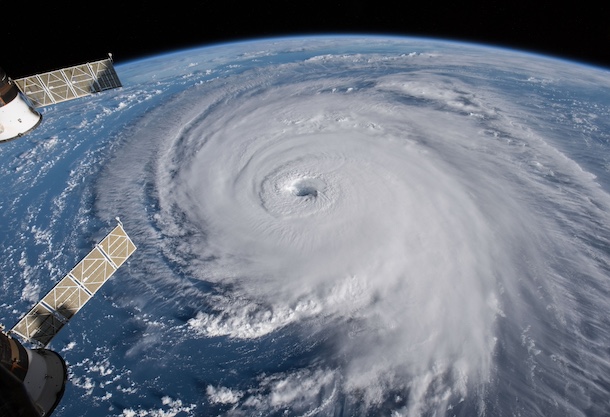
Shown above is Hurricane Florence in 2018. Abdalati warns that a lack of understanding about atmospheric science puts us at greater risk when climate disasters strike. Tools like weather satellites are used by NCAR to forecast and track storms to reduce their impact. (Photo: NASA/Goddard Space Flight Center, Wikimedia Commons, CC BY 2.0)
CURWOOD: By the way, to what extent do you believe that we should all be very concerned, indeed, alarmed about the climate emergency that seems to be advancing?
ABDALATI: I think we should be very concerned. But I would frame it a little bit differently. I would hope that everyone in this country, everyone in the world, would appreciate the importance of doing our best to understand what the future holds, so we can be best positioned to manage the challenges that come with it and capitalize on the opportunities that may come with it. So to be critical of the research itself is a tremendous disservice to the country. Speaking individually, I'm not speaking on behalf of the science community or anyone else, I'm very concerned, because the physics are pretty basic. If you put heat trapping gas in the atmosphere, it will trap heat. More heat in the atmosphere has certain implications for the environment we've lived in for centuries, and so I'm very concerned about the challenges that may lie ahead, but my concern is much further exacerbated when we try to avoid understanding what those challenges may be. And I see this effort and others that I'm seeing as compromising our ability to know what lies ahead, and as a result, I think it greatly compromises our national interests.
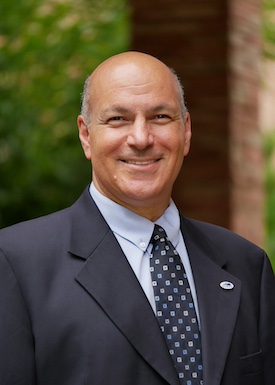
Professor Waleed Abdalati is a former chief scientist at NASA and the director of the Cooperative Institute for Research in Environmental Sciences at the University of Colorado, Boulder. (Photo: Courtesy of Waleed Abdalati)
CURWOOD: You know, by the way, federal funding for climate and environmental research has faced a lot of uncertainty recently, including some impacts on your own lab there. How has that uncertainty affected your team, both in terms of functionality and morale?
ABDALATI: Well, that uncertainty has had a tremendous impact on morale, and when morale is low, people don't function as well as they otherwise would. So I think the environment, the removal of a huge percent of the workforce on the federal side, the challenges to grants and so funds are not flowing, really takes a toll on our people, and in some cases, a real financial toll, and they're unable to do the work that they've dedicated their careers to. And I just want to say people don't do this work for the glamor or for the money. People do this work because they care. And I think when a person has dedicated their careers to something like that, and all of a sudden there's kind of a, you know, it's not worth doing. We don't support it anymore. That really is a challenge, and it has a huge, huge impact on morale and ultimately, I think the work that people are able to do.
CURWOOD: Waleed Abdalati is the director of the Cooperative Institute for Research and Environmental Sciences at the University of Colorado, Boulder. Waleed, thanks so much for taking the time with us today.
ABDALATI: Of course. Thank you so much for covering this important story.
*After this story went to air and was published, we received word that Gov. Polis commuted Tina Peters' sentence and plans to release her early, on June 1, 2026.
Links
Nature | “World-Leading Climate Centre Takes Trump Administration to Court”
Living on Earth wants to hear from you!
Living on Earth
62 Calef Highway, Suite 212
Lee, NH 03861
Telephone: 617-287-4121
E-mail: comments@loe.org
Newsletter [Click here]
Donate to Living on Earth!
Living on Earth is an independent media program and relies entirely on contributions from listeners and institutions supporting public service. Please donate now to preserve an independent environmental voice.
NewsletterLiving on Earth offers a weekly delivery of the show's rundown to your mailbox. Sign up for our newsletter today!
 Sailors For The Sea: Be the change you want to sea.
 The Grantham Foundation for the Protection of the Environment: Committed to protecting and improving the health of the global environment.
 Contribute to Living on Earth and receive, as our gift to you, an archival print of one of Mark Seth Lender's extraordinary wildlife photographs. Follow the link to see Mark's current collection of photographs.
 Buy a signed copy of Mark Seth Lender's book Smeagull the Seagull & support Living on Earth
© Copyright World Media Foundation. All Rights Reserved
Home | Contact | RSS | Donate | Newsletter