

Freedom Trees and The Pecan Master
Air Date: Week of June 12, 2026
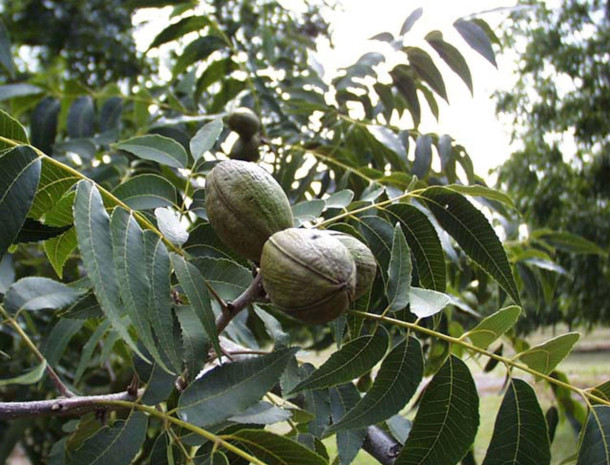
The first grafted pecan tree was based on the agricultural work of an enslaved man named Antoine. Grafting allowed the commercial pecan industry to thrive in the United States. (Photo: Brad Haire, University of Georgia, USA, Wikimedia Commons, CC BY 3.0 US)
Host Steve Curwood and author Beronda Montgomery continue their conversation about her book, When Trees Testify: Science, Wisdom, History and America’s Black Botanical Legacy. They discuss abolitionist Harriet Tubman’s use of the sycamore tree to help guide enslaved people to freedom, how an enslaved man named Antoine made a breakthrough to graft a successful variety of pecan tree, and the significance of trees as physical companions and powerful metaphors for resilience as we celebrate Juneteenth and remember the end of slavery.
Transcript
CURWOOD: It’s the Living on Earth Juneteenth special, I’m Steve Curwood, celebrating the Jubilee of freedom from slavery here with Beronda Montgomery, author of when Trees Testify.
CURWOOD: As part of dealing with enslavement and at times self-emancipation, trees are part of the story. Talk to us about what Harriet Tubman said about trees like the sycamore.
MONTGOMERY: You know, one of the things that I loved about writing this book was learning even new things about Harriet. So, Harriet had quite a great understanding of trees from having worked in tree fields with her father, and she had learned that sycamores were trees that could lead you to freedom, because these trees are quite distinctive in the way that they're looked by their bark, but they're also near bodies of water, and she had learned to navigate and look for such, what she calls a forest compass, to help lead her in different directions. And so she had a great knowledge and expertise around trees, and I learned when writing this book, Harriet also had a great love for apple trees that I hadn't been aware of. Someone pointed out a children's book for me, and her love for those apple trees was linked to the fact that she had to help grow them when she was enslaved and couldn't eat the apples, and so when she got her homestead in New York, she planted hundreds of fruit trees and was known to offer people apples when they came as a sign of freedom that she could now do that. And so Harriet's engagement with trees is deep and really led to her ability to be the greater liberator that she was in so many ways.
CURWOOD: And talk to me about how does the sycamore help you find your way north?
MONTGOMERY: So sycamores, in particular, are trees that have a very distinctive bark, in that when the tree grows, unlike other trees that may just make rivets and fill in, it sloughs off part of its bark like a snake would an old skin to have a new skin. And so, the sycamore tree often has this very light gray, but also mottled peeling bark that makes it very distinctive. You can see it amongst other trees, and at nighttime, when the moonlight hits it, it's very easy to see, and so if you knew where the sycamores were in the area, and you could find them, you could use them to navigate. But the other thing is that sycamores grow very well on the bodies of water, on the shores of bodies of water, so if you would see a number of sycamores growing together, it was likely that they were near a river or body of water, because they stabilize the soil, and so enslaved people would often look for sycamores to find a body of water that they could pass through, so their scent would be lost in case hounds were used to follow them. Sycamores also have very large trunks that are often hollow, so you could hide within one, or you could hide things within one as you were preparing. So sycamores had very many different ways that they were useful for people who were seeking to liberate.
CURWOOD: So Harriet Tubman loved planting fruit trees, and later in life, and being able to offer apples, apples that she couldn't have eaten when she was a child. Of course, apples are integral to American folklore, as apple pie, as they like to say, right, but apples are, of course, part of the African American story, and in your book, you write about apples playing a key role in a pioneer story, an African American pioneer story in New Mexico. What happened there?
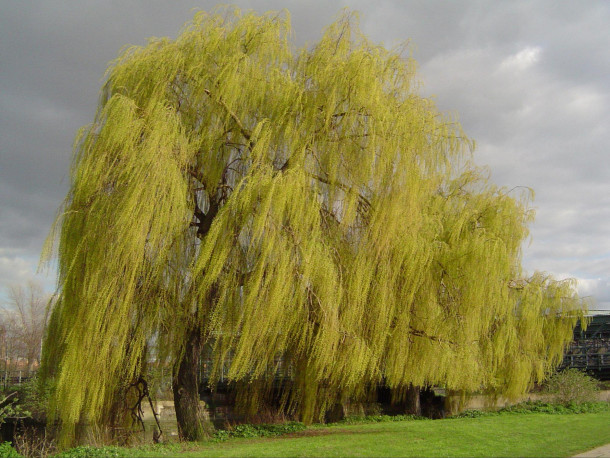
Beronda says willow trees are her favorite trees. (Photo: Louise Joly, Flickr, CC BY-NC-ND 2.0)
MONTGOMERY: I was so happy to come to know about that story, because I wanted to be able to include stories in When Trees Testify that acknowledged the trauma of trees, but also showed the ways in which trees were linked to joy in the pursuit of freedom for African Americans. So there is a town that was known as Blackdom in New Mexico. It was a first black settlement in New Mexico that was founded by Frank and Ella Boyer, one of the couples that founded it, and Frank had been Francis Boyer had been seeking to leave Georgia because he was running into issues protesting their Jim Crow laws, and so they identified New Mexico as a state that had no Jim Crow laws and knew that if they could go there and establish a town they would be able to move freely, at least compared to their life in Georgia. And so Frank and Ella Boyer and other couples started this town and recruited people who had agricultural abilities; they wanted people to be able to grow their own food, but also to be able to grow crops, so that they could use them for cash crops, and some of the first things that they grew were apple trees in the desert. And that was due to their having inherited abilities to do dry farming and to do very good ways of watering in the desert, irrigation in the desert, and so they were able, Francis Boyer and his son were so successful with growing apple trees that they made significant money and were able to loan money to others to be able to come. And Blackdom was founded in about 1903 and they thrived there for a couple of decades before they moved to another town in New Mexico, Ledoux, but it really was central to their being able to pursue freedom in an area that was free of Jim Crow laws that restricted their lives in the Deep South.
[MUSIC: Hal Leonard Jazz Ensemble, “Cotton Tail” by Duke Ellington/arranged by Mark Taylor, on Young Jazz Classics - Grade 3]
CURWOOD: You wrote about rice and pecan cultivation, and you highlighted the knowledge that enslaved Africans brought to America and contributed to the growth of the U.S. economy with those skills, yeah, that enslaved Africans brought more than simple hard labor is key. So, you know, I mean, feels to me it's important to tell those stories. Yes?
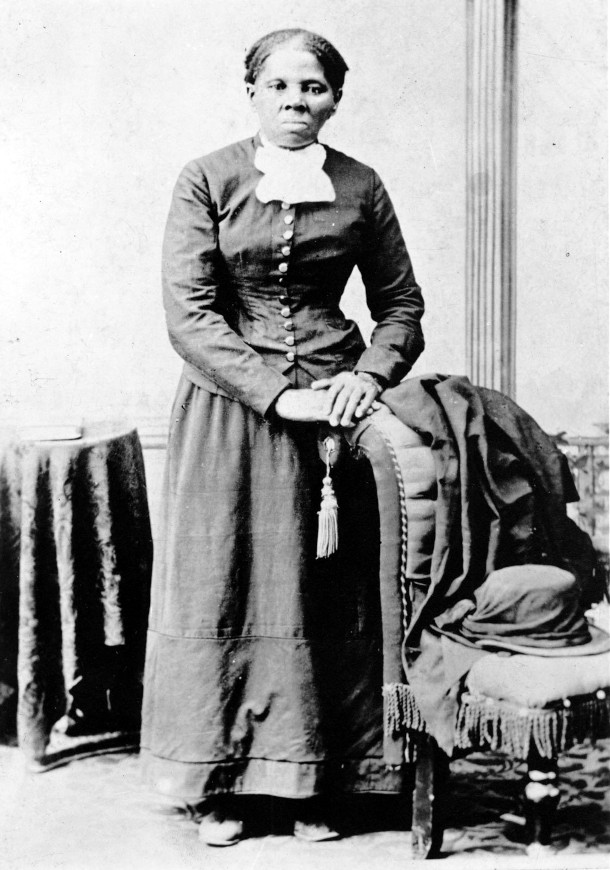
Harriet Tubman was an abolitionist who helped lead thousands of enslaved people to freedom via the Underground Railroad. Schooled in plants and trees, Tubman used her knowledge of sycamores and willows to guide her during her travels northward. Author Beronda Montgomery tells the story of Tubman growing apples on her homestead in upstate New York using knowledge she gained as a child during enslavement. (Photo: Harvey B. Lindsley, Wikimedia Commons, Public Domain)
MONTGOMERY: It's vitally important, and I think some people have started to acknowledge this, particularly in terms of like rice, some of the women that were enslaved from West Africa, they went to areas where they knew there was successful cultivation of rice in those areas, and wanted women to be brought here who could plant and irrigate the rice and allow it to really thrive. And so much of the thriving of the rice industry sits at the hands of those enslaved African women, and this was so well known that enslavers actually paid very highly for women who came for this area; their value was as much as young men, which was how you would really estimate what value was at that time. In terms of the pecan industry, it's known that the first grafted pecan tree, which was one that was the basis of the commercial pecan industry, was actually obtained at the hands of an enslaved man named Antoine, and so pecan trees growing in nature have nuts of very varying size, some that have hardly any nut meat, and some that have a lot, and so they had to really get a variety that would make nuts of the same size with very healthy, large amounts of nut meat, and this happened after Antoine was able to successfully graft a variety that was known as Centennial. So there are many areas in agriculture, like rice, pecans, tobacco, where we can point to the breakthroughs in that leading to commercial industries being founded upon the knowledge of enslaved people, and in that way it started to seem to me that my own personal legacy as a botanist was really founded on an expertise and a kind of pride in carrying on that expertise, and that's one of the things I wanted to be able to share in the book, the ways in which we've overlooked those contributions quite heavily in the U.S. in terms of African Americans' contributions to this country's agricultural wealth and advances.
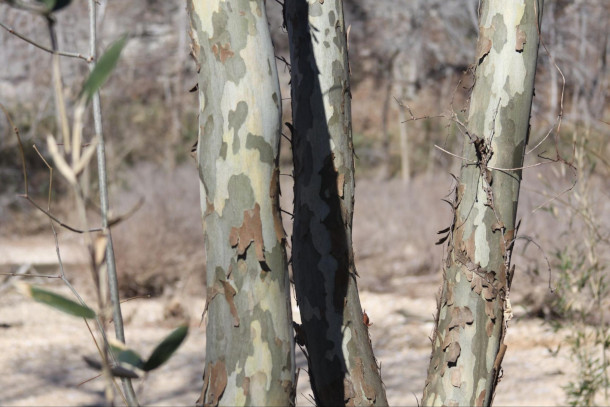
The distinctive bark of sycamore trees served as navigational guides for people seeking freedom from enslavement. Sycamore trees also provided hiding places for people and objects. Above, sycamores in Buffalo National River Arkansas. (Photo: National Park Service, Wikimedia Commons, Public Domain)
CURWOOD: Much more to the story than George Washington Carver, huh?
MONTGOMERY: Absolutely, and I, you know, I want George Washington Carver to be celebrated, but I also want us to have more than one name we can call when people ask what black people have contributed to agricultural in this country.
CURWOOD: Talk to me about what Antoine did to graft and make essentially, I don't know if you call them a hybrid or whatever trees that would then be more commercially valuable. I don't think grafting is a very simple or easy thing to do.
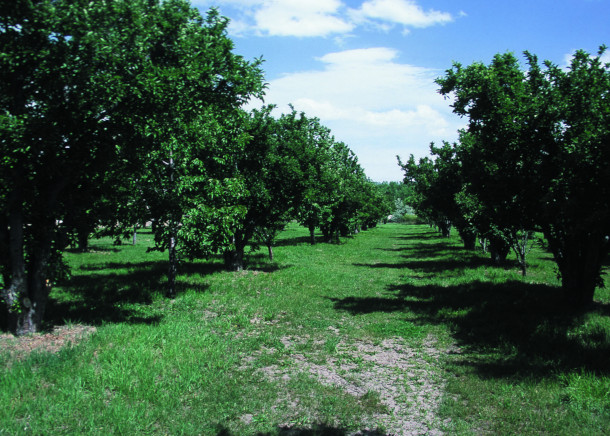
Blackdom, one of the first Black settlements in New Mexico, was a community founded by Frank and Ella Boyer. Their ability to grow their own food, particularly apple trees, allowed them financial freedom during the Jim Crow era, says Montgomery. Above, an apple orchard in Rio Arriba County, New Mexico. (Photo: Jeff Vanuga, Wikimedia Commons, Public Domain)
MONTGOMERY: It's not. I have tried it, and by and large, I've been mostly failure at it. It's very difficult to do because you're taking two separate parts of a plant, a root of one part of a plant, and the stem or top of another plant, and trying to fuse them together, and it's much more likely that you introduce some kind of problems that it's not successful. The reason they needed to do this is that when you got pecan trees that could make these very large nuts, often the tradeoff is that they were susceptible to stress and damage. And so what they wanted to be able to do was to use the top of the tree that would produce the large nuts and graft it onto a rootstock that was resistant to pest in the soil, so that you could have a hardy tree that could still make a lot of nuts. And so Antoine had to do some trial and error. Part of this came from probably long, many generations of observations in the wild, grafting can happen in the wild, in the woods, in certain ways, and if you're observing how that can happen, it can help you understand how to put two parts together. And so he was able to do this, and when you think about, I've done it with lots of advanced tools and sterile cabinets and all kinds of things, and thinking about him being able to do this at a time where he would have had access to fewer tools and technological advances is even more inspiring to think about the dedication and persistence it must have taken for him to be successful at accomplishing that.
CURWOOD: So he would have done it a few times, a few dozen times, maybe?
MONTGOMERY: Probably a few dozen times, and very frequently it doesn't work. And you know, I also think about him doing it under the duress of being tasked with doing that by a slave master, right, by someone who was in charge of him, and so he would have had to do that many, many times under significant stress, but somehow he managed to get it to work, and in fact it was the basis of the pecan industry in the U.S.
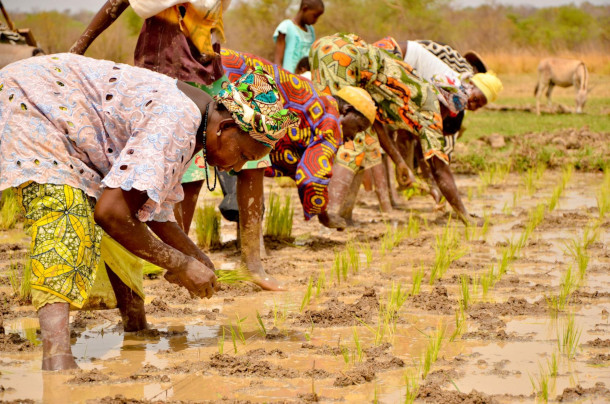
The art of growing rice was integral to West African culture. Enslaved women from rice growing areas like the Gambia were brought to the rice growing areas in the Carolina low country and other parts of the South. Above, people working in the rice fields of The Gambia. (Photo: Sheena, Flickr, Public Domain)
CURWOOD: And we don't know his last name.
MONTGOMERY: We don't know his last name.
[MUSIC: Hal Leonard Jazz Ensemble, “Cotton Tail” by Duke Ellington/arranged by Mark Taylor, on Young Jazz Classics - Grade 3]
CURWOOD: As a botanist, I know you also think about trees and their roots, and of course, you're thinking about African American history and enslavement. What can trees and their roots tell us? How can it enlighten us about the human situation, how people can survive and thrive something like enslavement?
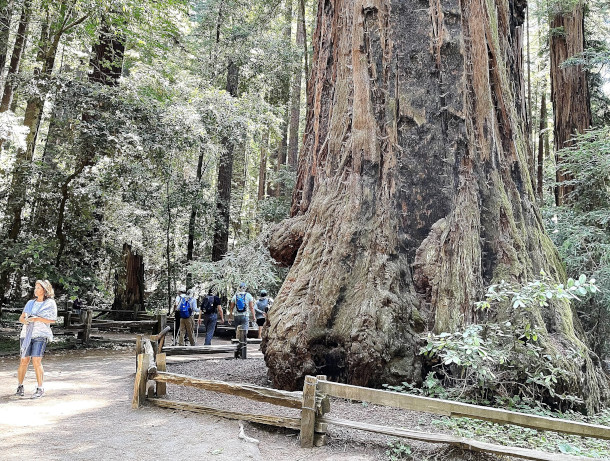
Montgomery encourages everyone to connect with trees and nature to the best of their ability. Above, visitors walk through Henry Cowell Redwoods State Park in California, home to some of the largest trees on Earth. (Photo: Marty Aligata, Wikimedia Commons, CC BY-SA 4.0)
MONTGOMERY: I think when you think about different trees, whether you think about an oak tree that has a really deep central root, or you think about trees like sycamore and willow that have a more robust, networked, shallow roots, I think that the roots of trees adapt to the environments in which they're growing to stabilize themselves. And so they are constantly kind of sensing that environment and adapting, whether they do need to branch out to get themselves stable, or if there's a deep tap root, which is the thing that is keeping you anchored. The other thing that I think a lot about is that the soil and the roots are constantly, there's a communication and a community that's actually happening underground. The roots are not living in isolation, they're often collaborating with bacteria or fungi in the soil, and it's that community together that allows the roots of the tree to have its strongest, most complex, and deepest ability to support the tree. And so I think a lot about there are times where, for me, I think the beauty of being a human is that I'm neither an oak tree or a willow tree, and there are times where I need to put a deep root down because I'm in the right place, and there are other times where I have to have this highly networked and shallow root system to have sustainability, but in both of those cases there is always a community that is the full support of the plant and the tree, and I think that for me that's what was wonderful about being able to look at family stories, in addition to science, is to acknowledge some of that community that has sustained me, and that I hope we all see as a paradigm for how we are sustained in our lives.
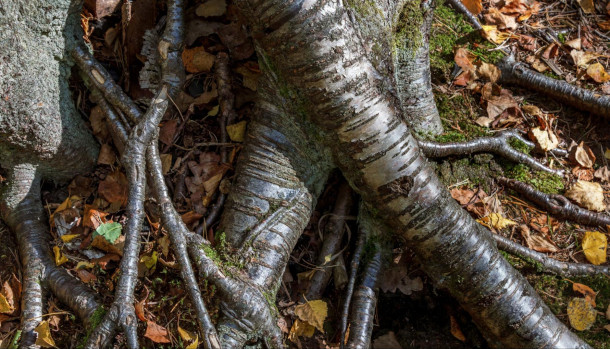
The intertwined roots of two birch trees. Our guest suggests that tree roots can symbolize adaptability, resilience, and community. (Photo: W.carter, Wikimedia Commons, CC BY 4.0)
CURWOOD: Talk to me more about community, as I understand it, many trees have to be with other trees in order to thrive. How true is that?
MONTGOMERY: It's very true. Most trees, there are always outliers. Some trees, like black walnut, appear to like to keep it just for themselves. They will create chemicals in the soil to prevent it, but most trees are very most robust and most resilient to stress and damage when they are in communities both with kin trees and trees that have unique abilities. And so there is a lot of evidence from Indigenous science into Western science showing that diverse communities of trees are often the most robust and the most resilient.
CURWOOD: What do you think it means for people who live where there are no trees in the middle of cities, like concrete jungles around housing projects, and in a number of inner cities?
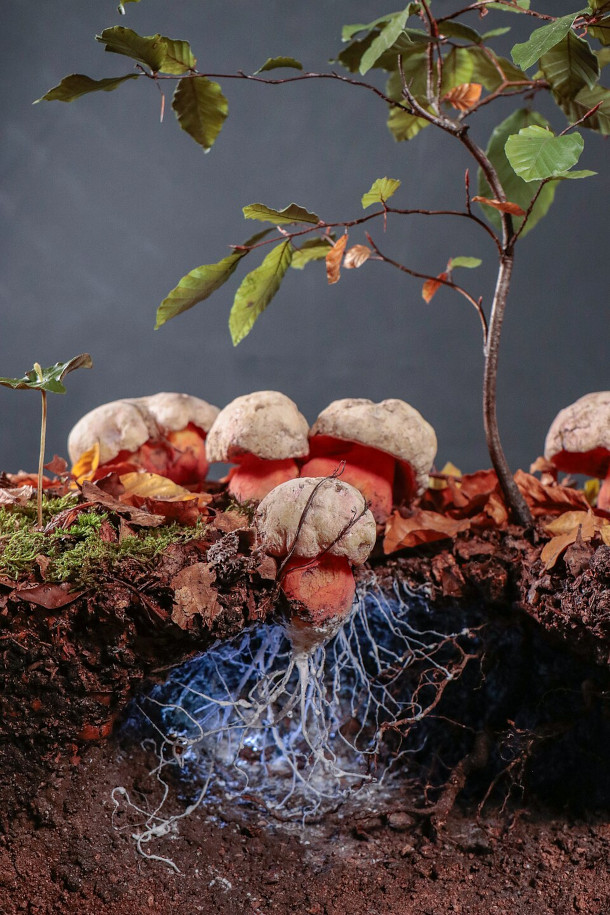
Montgomery also notes that trees are never living in isolation; tree roots often communicate with networks of fungi and bacteria to pass important nutrients through the soil. She likens this relationship to the importance of community in our lives. Above, a diorama of a fungus known as the devil’s bolete, interacting with the roots of a beech tree. (Photo: Sebastian Brandt, Wikimedia Commons, CC BY 4.0)
MONTGOMERY: You know, I think part of that is evidence of a challenge that we've had in this country, I think about Robert Bullard and others who've talked about environmental justice, and often our ways in which we've moved into spaces have caused us to move plant life and other life out, and I think that there are costs to that. I think that it is a deficit when people aren't able to engage with trees, and sometimes they find parks in other places in the city, but for me, I find it a little sad when we don't have those spaces where we have access to trees, the oxygen that they produce, but also the relationships that we can have with them.
CURWOOD: Beronda, what do you hope readers will take away from When Trees Testify?
MONTGOMERY: You know, it's my hope that the stories that I'm able to share and the science that I'm able to share may get people to take a second look at trees and to think about how they think about them as a part of their own lives, to be more aware of the trees that they live with. You'd be surprised how many people don't even know the trees in their yard, or how many there are. I also hope that the idea that our breath is captured in the trees may get people to think about who's lived with the tree before they have, and to have interest in their life, but also, and I know I'm a little bit - my son says I get a little bit too deep, but for me this idea that my breath is captured by the tree has caused me to think about what it means to live a life worthy of that, and I hope that people will just think about, you know, what it means for us to live together with trees on the planet, and for anyone who's been impacted by an old tree, how are you living such that people in future generations might also have that opportunity. So, I want people to think differently about trees and what it means to live together with them.
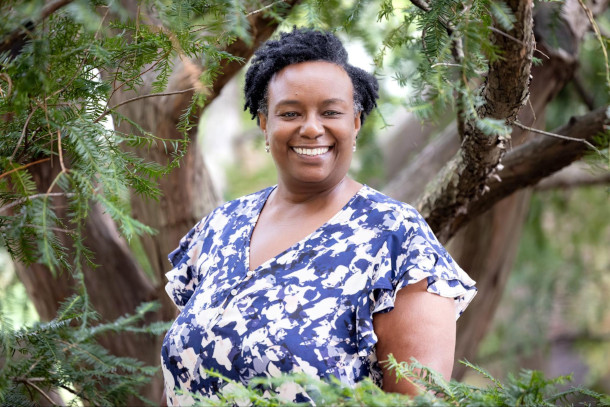
Beronda L. Montgomery is a science communicator, researcher, and author of When Trees Testify: Science, Wisdom, History, and America’s Black Botanical Legacy. (Photo: Courtesy of Beronda Montgomery)
CURWOOD: Beronda Montgomery is the author of When Trees Testify: Science, Wisdom, History, and America's Black Botanical Legacy. Beronda, thanks so much for taking the time to speak with us.
MONTGOMERY: Thank you so much for the opportunity.
CURWOOD: The right to live their own lives that was finally granted to enslaved Americans in the Jubilee of 1865 is celebrated today as Juneteenth. Folks party with music, dance and lots of red foods. Strawberry soda and hibiscus tea, red beans and rice, red velvet cake, watermelon and of course, barbeque. And the sweetest taste is of freedom, finally won to atone for America’s original sin of buying and selling people. Jump for joy!
Links
Harvard Radcliffe Institute | Learn more about Beronda Montgomery
Oprah Daily | “The Traditional Foods of Juneteenth Carry a Rich History”
Living on Earth wants to hear from you!
Living on Earth
62 Calef Highway, Suite 212
Lee, NH 03861
Telephone: 617-287-4121
E-mail: comments@loe.org
Newsletter [Click here]
Donate to Living on Earth!
Living on Earth is an independent media program and relies entirely on contributions from listeners and institutions supporting public service. Please donate now to preserve an independent environmental voice.
NewsletterLiving on Earth offers a weekly delivery of the show's rundown to your mailbox. Sign up for our newsletter today!
 Sailors For The Sea: Be the change you want to sea.
 The Grantham Foundation for the Protection of the Environment: Committed to protecting and improving the health of the global environment.
 Contribute to Living on Earth and receive, as our gift to you, an archival print of one of Mark Seth Lender's extraordinary wildlife photographs. Follow the link to see Mark's current collection of photographs.
 Buy a signed copy of Mark Seth Lender's book Smeagull the Seagull & support Living on Earth
© Copyright World Media Foundation. All Rights Reserved
Home | Contact | RSS | Donate | Newsletter