
Public Power and Industry Pushback
Air Date: Week of October 9, 2026
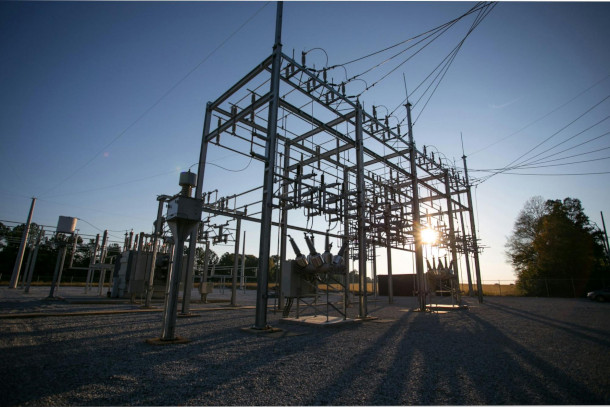
An electrical power station in Huntsville, Alabama, where the electric system was municipalized in 1940. (Photo: American Public Power Association, Unsplash, Unsplash License)
In Ann Arbor, Michigan, public power advocates have battled since 2018 to take electricity non-profit, and hope to win a referendum vote in November. But strong opposition from dividend-paying DTE Energy is being stoked by an alleged misinformation campaign with claims of higher costs of going public from what seems to be at least one citizen group that is in fact funded in part by DTE. Tom Perkins wrote about this for the Guardian Newspaper and speaks with Host Steve Curwood.
Transcript
DOERING: It’s Living on Earth, I’m Jenni Doering
CURWOOD: And I’m Steve Curwood.
According to the American Public Power Association, the customers of municipally owned electric utilities pay on average about 15 percent less for electricity than those served by investor-owned utilities, and based on the math alone, it would seem to be an easy choice for voters when asked. But back in 1923 when the citizens voted to create SMUD, the Sacramento Municipal Utility District as a community-owned, not-for-profit electric service they had to wait until 1946 to actually get started, thanks to push back in the courts from PG & E. Current efforts to move to public power are also taking patience as they face headwinds in San Diego, California, St. Petersburg, Florida and Ann Arbor, Michigan. There, public power advocates have battled since 2018 to take electricity non-profit, and hope to win a referendum vote in November. Strong opposition from dividend-paying DTE Energy is being stoked by an alleged misinformation campaign with claims of higher costs of going public from what seems to be at least one citizen group that is in fact funded in part by DTE. Tom Perkins wrote about this for the Guardian Newspaper and joins me now from near Detroit. Welcome to Living on Earth, Tom.
PERKINS: Hi, thanks for having me.
CURWOOD: How are these front groups created, and just what do they do? How do they operate?
PERKINS: Yeah, this isn't totally unique. This is something that industries, not just utility industry, do. I've seen this in my reporting on chemical industry and gas and oil companies will set up these types of front groups, but in this case, they hire a consultant, somebody who who knows the industry. It varies by state, but they set up a nonprofit or some kind of organization, and they put sort of a a community vibe on it. That if the average person looks at their marketing material or their mailers or their website or whatever, they might think, "oh, okay, here's a bunch of my neighbors out fighting against this thing" but if you scratch even a little bit below the surface, there are signs that point to it not really being a grassroots effort.
CURWOOD: So the Ann Arbor Responsible Energy Coalition (A2REC) was started in response to this ballot initiative coming up in November. What is that ballot initiative pushing for exactly?
PERKINS: It's pushing for the full municipalization of Ann Arbor's grid. So the city of Ann Arbor would take over the grid and be responsible for not just delivering the power, but they might have to buy it from DTE Energy. They might have to buy it from some other company, and then they would also, you know, they plan to to build out their own clean energy generation, so solar and other means to, you know, provide clean energy, which DTE Energy hasn't done a whole lot of here, but they would take over the grid, break that off from DTE, and the city of Ann Arbor would be then in charge of all the maintenance, all the upkeep, all the improvements, and making all the decisions about it going forward.
CURWOOD: So I believe that there's another major point of the November elections in Ann Arbor: is the candidacy of a new mayor who defeated the incumbent in the Democratic primary, talk to me about this candidate. What's his name?
PERKINS: Yousef Rahbi, he is a former state legislator who, while he was in the state house, was a thorn in the side of of DTE and Consumers Energy, the two big investor-owned utilities in the state, regularly introducing legislation to boost rooftop solar and rein in DTE's price increases, and he ran for he's a member of the DSA. He ran against an incumbent mayor who's been there for a long time, and he's also one of the leaders of the public power push in Ann Arbor, and that was a key piece of his campaign. And I think it really probably bodes well for the public power initiative's chances that Yousef really cleaned up in the primary.
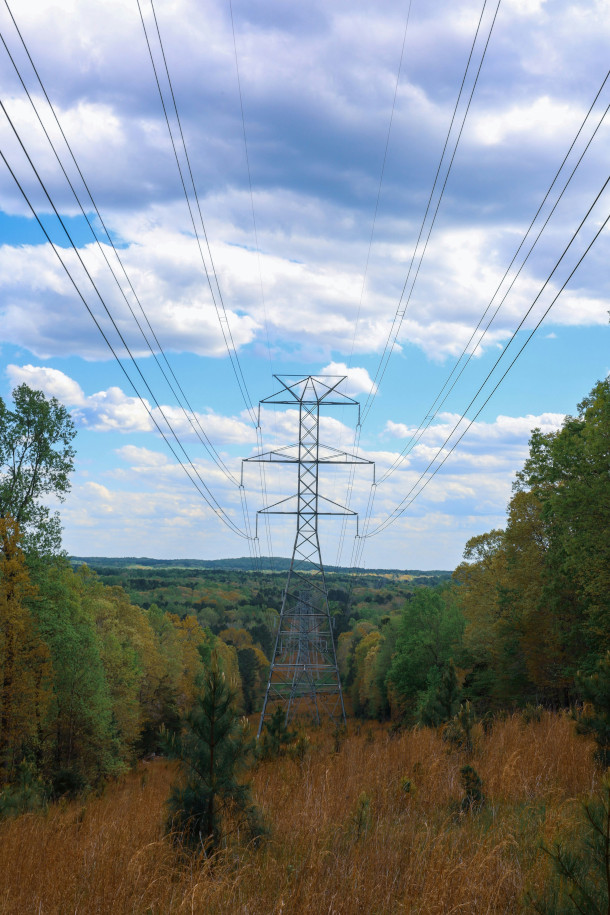
Overhead power lines transport electricity from a power plant across an electrical grid. In the case of municipalization, these structures are transferred from private to public ownership. Here, a power line stretches out over Durham, North Carolina, where the electrical grid is privatized. (Photo: Brandon Griggs, Unsplash, Unsplash License)
CURWOOD: You've talked to people across Michigan about DTE Energy, and there seems to be a lot of pushback against this company. Why does it face such headwinds from some consumers and activists?
PERKINS: There are a lot of problems with DTE, and and it's gone on for decades. For a long time, we've had among the most unreliable service in the nation, and among the highest rate increases. And this all goes back to DTE in the past decades, in the past 40, 50, years, not investing enough money in improving the grid and taking shortcuts on tree trimming, and so we're in the situation now where the climate's changing. May, June, we're getting more strong storms, high winds, and trees down, and branches falling, and you just have decades of disrepair, and trees that are right up against the power lines, and so there have been some storms where a million people are without power, and it takes a week or two for some of those people to get the power turned back on, and the problem is the worst in the low-income areas in Detroit, where there's been some population loss, and so it's just been building over the last, I think, 10 years or so. And again, it's just it coincides with these really strong storms that we're getting as the climate changes.
CURWOOD: So that's a strong indictment on one side. What does the company say about its performance on the other? How does it defend itself?
PERKINS: Well, the company executives say things to reporters like, Oh, well, we live in Michigan. There are all these wonderful trees. It's beautiful here, but you know those trees-they'll knock the power lines out. They'll get blown over in a strong storm, etc. etc. But I've compared the reliability in Michigan to similar states like Wisconsin and Minnesota, and the power companies there have done a much better job trimming, and they don't have the same problems that we have here. This is directly result of DTE taking shortcuts on trimming the trees.
CURWOOD: So let me ask you, what are the chances in your mind of this public power ballot initiative passing?
PERKINS: I think it has a good chance of passing. People are frustrated with the company, and they're tired of paying high rates, they're tired of the power going out, so we'll see. But DTE’s, they have set up a front group here, and and they're fighting back. So it's hard to say, but I think there is a good chance that it passes.
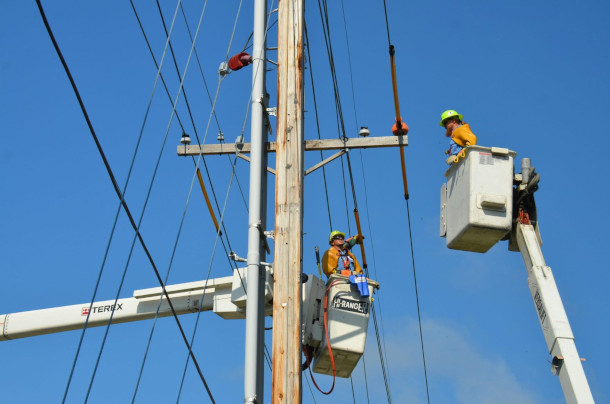
Linemen on cherry-pickers work on power lines in Bryan, Ohio, another municipalized electric system. (Photo: American Public Power Association, Unsplash, Unsplash License)
CURWOOD: In your view, what's the quality of the information that people are given by this group, the Ann Arbor Responsible Energy Coalition?
PERKINS: Yeah, A2REC is what they go by. They send out mailers that cite a lot of I would say what can fairly be called manipulated data of what it would take to switch to a municipal utility, like in terms of cost and resources. DTE wants to make sure that voters think that the cost up front is just too steep, and so that's the kind of thing that you see in in the mailers and in their information is oh this is going to be impossible, so let's not even try, let's do something else.
CURWOOD: By the way, not so long ago, a push, a referendum for public power in Maine went down to defeat. To what extent do you think that's related to this kind of tactics of apparent community groups getting a lot of money to oppose?
PERKINS: Yeah, it was the utility industry used the same tactics there. There was a front group that was set up and was in the mix and pushing many of the same talking points, and that's a great example of why the utility industry sets up these front groups, sometimes they're effective. I think I wrote a little bit about Maine when they were trying to get things together early on, and they had a lot of momentum, and it really felt like they were going to succeed. And then industry hit back, and one of the ways that they hit back was to deploy a front group that spread misinformation, and ultimately the public power proposal went down. So, you know, I mean, these things are effective. My sense in Ann Arbor is that most people see through this. This has been something that's been talked about so much. People understand the lay of the land with DTE, and they understand what's going on, and they understand where most of their neighbors are at with DTE. So even on its face, the idea that a bunch of people are going to get together, that there's going to be a grassroots effort to back DTE, I think most people are skeptical of that.
CURWOOD: So Tom, what else is on the ballot now statewide in Michigan about this issue? What could happen?
PERKINS: Yeah, there's an initiative that would prohibit DTE Energy, Consumers Energy, the other major investor-owned utilities from making political donations, which would really go a long way toward breaking DTE's grip on the legislature, and I think there's a little bit of a synergy here between what's going on in Ann Arbor and and that statewide effort. I think the statewide effort has pretty broad bipartisan support, and people in Ann Arbor are are excited about both of them, and I think they can draw the connection between the high bills, the the power going out frequently and for a long time, and what happens at a local level if they take over the grid, and that's only going to propel the the local initiative.
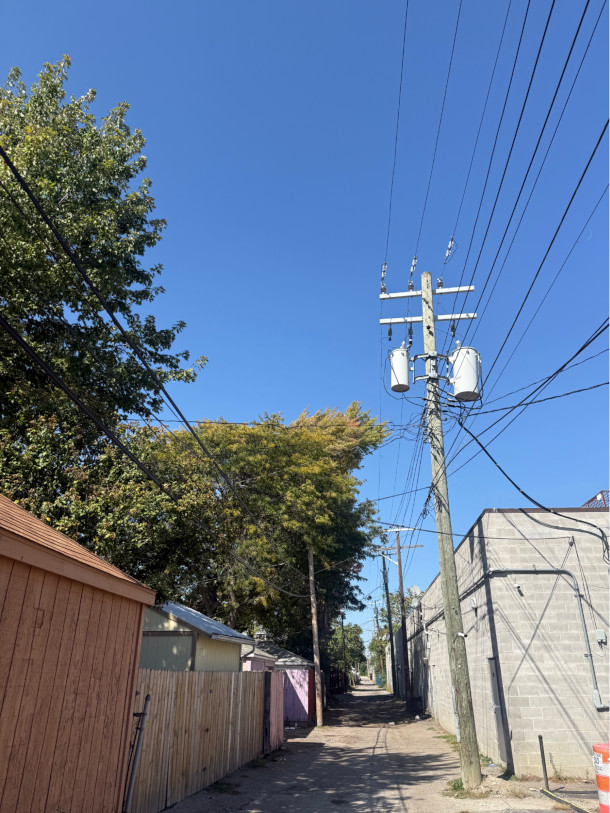
A utility pole owned by DTE Energy in Ann Arbor, Michigan. Residents have reported complaints of trees covering their power lines. (Photo: Courtesy of Tom Perkins)
CURWOOD: To what extent do you think that concerns about the climate emergency are driving this push for public power for publicly owned utilities?
PERKINS: Publicly owned utilities are are generally a lot more responsive to the customers, and customers generally want things like clean energy. People more and more draw the connection between the wildfire smoke and the the strong storms that we're having in Michigan and and all the other things that come with climate change and the gas plant down the road and the utility that doesn't want to change. People understand that that DTE Energy makes a bunch of money when it builds gas plants and it doesn't make as much money when it builds solar panels. So they know that a public utility is the way to go. That it's more responsive. You know that's like a reason why you see places like Ann Arbor and Saint Petersburg, Florida, and there's a municipalization effort in in Southern California around San Diego and and other cities. I mean that's like one of the big drivers. People get that this is a really a meaningful way to address climate change.
CURWOOD: Tom Perkins is a freelance reporter based in Michigan. Thank you so much for talking with us today.
PERKINS: Great, thanks for having me.
CURWOOD: On October 5, citing cost concerns, the Ann Arbor City Council voted nearly unanimously to oppose Proposal E, which is still on the ballot for voters to decide this November. We reached out to DTE Energy, which shared a statement that reads in part, quote: “DTE is focused on customer affordability, keeping energy bills below the national and regional averages, even as we continue to invest in delivering improved reliability and cleaner energy for our customers across the state.” A spokesman for the Ann Arbor Renewable Energy Coalition or A2REC provided an email response saying it has a broad membership base and “acknowledged that DTE, among other organizations, has been a funder of” its work. You’ll find both full responses on the Living on Earth website, loe dot org.
Links
Living on Earth wants to hear from you!
Living on Earth
62 Calef Highway, Suite 212
Lee, NH 03861
Telephone: 617-287-4121
E-mail: comments@loe.org
Newsletter [Click here]
Donate to Living on Earth!
Living on Earth is an independent media program and relies entirely on contributions from listeners and institutions supporting public service. Please donate now to preserve an independent environmental voice.
NewsletterLiving on Earth offers a weekly delivery of the show's rundown to your mailbox. Sign up for our newsletter today!
 Sailors For The Sea: Be the change you want to sea.
 The Grantham Foundation for the Protection of the Environment: Committed to protecting and improving the health of the global environment.
 Contribute to Living on Earth and receive, as our gift to you, an archival print of one of Mark Seth Lender's extraordinary wildlife photographs. Follow the link to see Mark's current collection of photographs.
 Buy a signed copy of Mark Seth Lender's book Smeagull the Seagull & support Living on Earth
© Copyright World Media Foundation. All Rights Reserved
Home | Contact | RSS | Donate | Newsletter