
The Carbon Wave
Air Date: Week of October 9, 2026
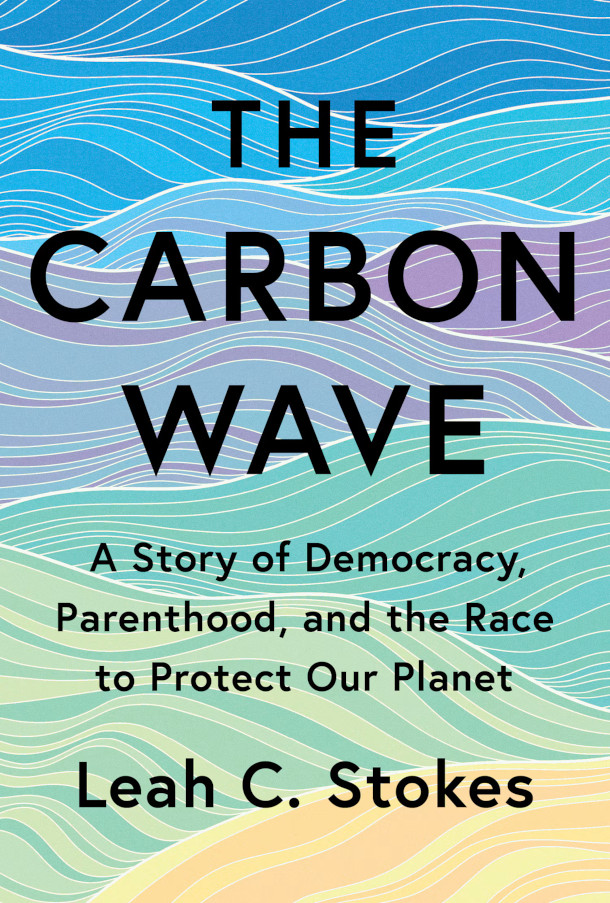
The Carbon Wave: A Story of Democracy, Parenthood, and the Race to Save Our Planet by Leah C. Stokes was released by MIT Press on September 1st, 2026. (Photo: Courtesy of MIT Press)
In 2022, President Biden’s signature climate bill appeared doomed in the 50-50 divided Senate when West Virginia Senator Joe Manchin, a centrist Democrat with close ties to the fossil fuel industry, declined to pledge his critical vote. But negotiations restarted in secret, and the largest climate package in US history became law. Leah Stokes’ 2026 book The Carbon Wave: A Story of Democracy, Parenthood, and the Race to Protect Our Planet tells the gripping story of how the Inflation Reduction Act came together and cleared the final hurdles, and she joins Host Jenni Doering.
Transcript
CURWOOD: It’s Living on Earth, I’m Steve Curwood.
DOERING: And I’m Jenni Doering.
Though it’s faded from public view amid this Trump administration, the 2022 Inflation Reduction Act is still largely intact and continues to deliver clean energy investments as the largest climate package in US history. And the turbulent story of how that bill became law is truly a political thriller, providing key insights into how major legislation works its way through a closely divided Congress and the White House. In 2022, with a 50-50 split in the Senate and Republicans staunchly set against any climate package, the only way President Biden’s signature climate bill could become law was through a special filibuster-proof process called budget reconciliation. That put West Virginia Senator Joe Manchin, a centrist Democrat with close ties to the fossil fuel industry, in the powerful position of being essentially the deciding vote. And since reconciliation has happened at most twice a year, the stakes were incredibly high. So, in July 2022, when Senator Manchin walked away from the negotiating table, it looked like the bill was dead. And then, it had a stunning resurrection as it rode a wave of public concern. The 2026 book The Carbon Wave: A Story of Democracy, Parenthood, and the Race to Protect Our Planet tells this gripping story of how the Inflation Reduction Act came together and cleared the final hurdles. Author Leah Stokes is an environmental politics professor at UC Santa Barbara who pushed for this strong climate bill to help usher in a clean energy transition. Leah, welcome to Living on Earth!
STOKES: Oh, thank you so much for having me on.
DOERING: Well, it's great to have you here. So, I want to start with the title of your book because I think it gives such a great insight into how you think about climate change and activism. You know, you you introduce this idea of the carbon wave as opposed to the, the familiar carbon footprint. What's the distinction? Why is this important?
STOKES: Yeah, so everybody knows what a carbon footprint is. If you go ask a normal person who doesn't want to listen to this amazing show, which they, there are people like that, hard to believe. People who aren't in the you know environment curious space, they will still know what a carbon footprint is, and so that concept has become a framework for how we think about the problem, and it's an idea that every person is responsible for, in the United States, something like 15 tons of carbon pollution a year. And what I try to show is that that makes no sense as a concept if you take a step back. We don't control the fossil fuel-based energy system. We were all born into it, even our grandparents were born into this system. But, the goal should be to not pass it along to the next generation, and so that points us towards working together to create infrastructure change or systemic change. And that can be as small as you know putting a heat pump in your house or getting an electric vehicle, or as big as you know changing a law, which is really what the book is about. So, I also created this carbon wave calculator on my own website that people can kind of explore what is this carbon wave idea and how can I sort of use it in my own life.
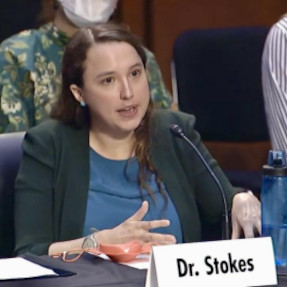
Leah Stokes has an extensive background speaking on climate and electrification issues. A holder of a PhD in public policy, she testified before Congress in the hearing titled “Examining the Economic Benefits of Electrifying America’s Homes and Buildings.” (Photo: U.S. Congress Joint Economic Committee, public domain)
DOERING: To harness the power that we all have.
STOKES: Yeah, I feel like in this moment, a lot of people are recognizing that democracy is a really powerful tool, and that if they join with others, they can change the world. They can protect their neighbors, for example. They can protect reproductive rights. They can really change the system, and it's the same for climate action. When we work with others, we can really be a force that goes way beyond our daily lives.
DOERING: Your book largely tells the story of this very monumental climate change legislation that took years and years to pass and eventually did become law. This is the Inflation Reduction Act, and you tell that story partly through the framework of new parenthood. It just so happened that you and several other people working on passing this bill were becoming parents at the time. Why did you decide to tell this story through that lens?
STOKES: So many people wonder if they should have a kid because of climate change, and that question actually has several sub questions within it. It's like, should I have a kid because the world is doomed, so that would be bad. And should I have a kid, even though they're just going to be another, you know, cog in the wheel of the fossil fuel-based, consumerist, terrible world? And what I'm trying to do here is debunk both of those ideas. That first of all, we're not doomed. The fossil fuel-based energy system was created by people, and it can be dismantled by people too, and in fact, it should be. And I also want to say to new parents who might be exhausted and changing diapers, and haven't even slept, to remind them that we can also find space in our lives for activism and to reach beyond the everyday. That we have a responsibility to create a better world, and that doesn't really matter if you're a parent or not. You should have a responsibility to do that for your neighbors, for your nieces and nephews, for all kinds of living beings on this planet.
DOERING: Yeah, absolutely. So the Inflation Reduction Act was this landmark win for climate action, but you were there through all the ups and downs. There's an especially gripping section of your book when the big climate bill looks to be dead, killed apparently by West Virginia's Democratic Senator Joe Manchin, and then in a bombshell we learn that he's come back to the table to support what becomes the Inflation Reduction Act. And when you hear about it, you're like, "What the heck is the Inflation Reduction Act?
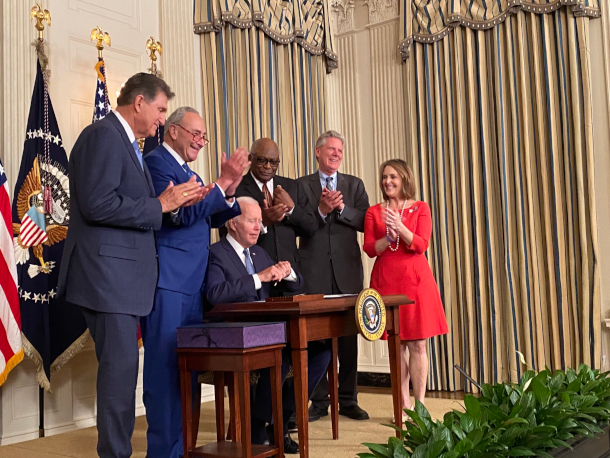
In August of 2022, then-President Joe Biden signed the Inflation Reduction Act into law. (Photo: Jennifer Granholm, Wikimedia Commons, public domain)
STOKES: Yes, exactly.
DOERING: It's got this new name. It preserves, I think, nearly all of the same climate investments. How fast did your head spin when you heard that news?
STOKES: Yeah, so it's been really fun writing this book because I got to learn behind the scenes about friends and colleagues, sometimes people I didn't even meet in the process, what it was like from their vantage point, and so my friend Adrian Deveny, who worked for Senator Schumer and was really his lead negotiator on climate, and he was inside that really tiny bubble when the world all thought that the climate bill was dead. He was one of perhaps 10 people who knew that the negotiations were still ongoing, and so I worked to understand in a lot of detail what was happening behind the scenes and telling that dramatic story. When in reality, when I was living it, I didn't know, I was on the outside, and so I literally just got a text message from him. I was reading my kids a story on the floor, a children's book, and at the end of the book, I looked at my phone, and there was a celebration emoji from my friend, and we were all mourning. We had all lost this bill two weeks earlier, and had spent much of that time depressed and sad and crying, and I didn't understand why he would send a celebration emoji at a time like this. And a few seconds later, my other friend Sonia Aggarwhal, who worked for the White House Climate Office, she sent a press release from Senator Joe Manchin's website that said the Inflation Reduction Act, that he supported it, and I was like, "What the heck is the Inflation Reduction Act?" Because Manchin had renamed the bill in this period when everybody thought the climate bill was dead, and so yeah, the book really tells the story from both vantage points, and it was a really fun part to write, and I think it's a real payoff for the reader too.
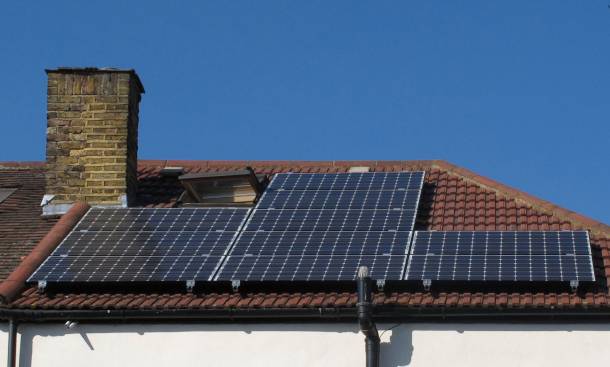
Putting up solar panels, installing a heat pump, purchasing an electric vehicle, or switching to an induction stove are all ways to electrify your life and start building your own carbon wave. (Photo: David Hawgood, Wikimedia Commons, CC BY-SA 2.0)
DOERING: Yeah, just gripping moments, I guess, to, to sort of live through that. And from your perspective, you wrote a pretty scathing op-ed about Joe Manchin killing this bill and just what a loss that was for the world. What do you think brought him back to the table? Like, was this his plan all along? Like, what was going on in Senator Joe Manchin's mind?
STOKES: Yeah. So, in fairness to Senator Joe Manchin, he really cared a lot about inflation and making sure that the economy wasn't going off the rails, and so he said in the press in the days leading up to this that he didn't know if they should be doing this climate bill. And then as I tell in the book, Senator Schumer calls up Senator Manchin and tries to say like, "Hey, look, we'll do everything you want," and Senator Manchin still wouldn't say yes, and so Schumer's team basically told the world that the deal had fallen apart. And the reaction that Thursday night was extreme anger from all kinds of people. It was also happening at a time when there was extreme heat waves. It's the summer, so these days the summer is climate disaster season, and so it felt like the whole world's anger about climate inaction was focused on this one man, fairly or not. And so by the next morning, he went on West Virginia talk radio and sort of tried to walk things back because I think he was getting called and texted and yelled at by pretty much everybody except perhaps the fossil fuel industry. He felt an enormous amount of pressure. I also wrote an op-ed in those days that ran in the New York Times. It was called "What Joe Manchin Cost Us," and it was very harsh.
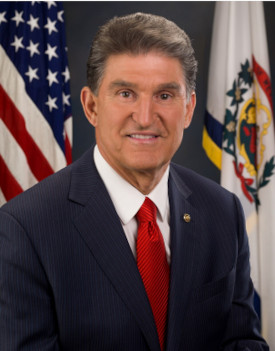
Senator Joe Manchin of West Virginia initially blocked the climate bill from passing, and Leah Stokes and her allies worked tirelessly to get it back on track. Eventually, he provided the deciding vote to pass the Inflation Reduction Act, the most consequential piece of climate legislation in United States history. (Photo: Rebecca Hammel, Wikimedia Commons, public domain)
And you know, it basically said that he was dooming his own grandchildren and that he strung everybody along. And so I think over that weekend he was under a lot of pressure from all kinds of corners. By Monday morning, as I tell it in the book, and as various journalists, including Jeff Stein at the Washington Post and Tony Rom, who's now at the New York Times, they reported that on Monday Senator Manchin went back to Senator Schumer and said, "Like, hey, are you mad at me? Do you think we could still do this?" And I sort of tell the dramatic way that the negotiations came back together behind the scenes, and there really were only a handful of people who knew-a couple people in the White House, people on Schumer's team and Manchin's team-and that was it. And they were sworn to secrecy because they just thought that if anybody caught wind of this and they failed again, it would be even worse. And there's also a lot of findings in political science that show that negotiations can actually benefit from some level of secrecy. You know, obviously in democracy, transparency is important, but you can get to a point in a negotiation where having too many people at the table and too much openness can make it harder to get to yes. So I think that the secrecy really helped because there was a story that the day that they eventually announced the deal, which was about 10 days later, Manchin met with all these fossil fuel executives on a Zoom call, and the day that they were about to announce, like, "Hey, we're actually doing this climate law," and those executives were just praising him, "Oh, you did such a good job killing this giant bill," and I think had they known that it was still on, think about all the lobbying they would have been doing and all the pressure they would have been pushing on him. Right, so I think that secrecy at the end was really important to actually landing the deal. You know, Senator Manchin's team they wouldn't talk to me for the book, which is fair enough, and I can't imagine that he likes me personally, which is also fair enough. But I did try to write it in a fair way, where I really tried to understand his motivations and treat him as a real human. He was an interesting senator in some ways, and I didn't agree with many things that he did. But he was also the deciding vote on the largest clean energy and climate investment in American history, and a lot of jobs went to West Virginia because of that. So, I think he's a more complex character than just sort of painting him as a one-dimensional villain.
DOERING: Of course, there were some provisions that Senator Manchin tucked into this bill that some climate activists really couldn't stomach. Fossil fuel leasing requirements, carbon capture support. What did you learn from this process about not letting, quote unquote, "the perfect be the enemy of the good?"
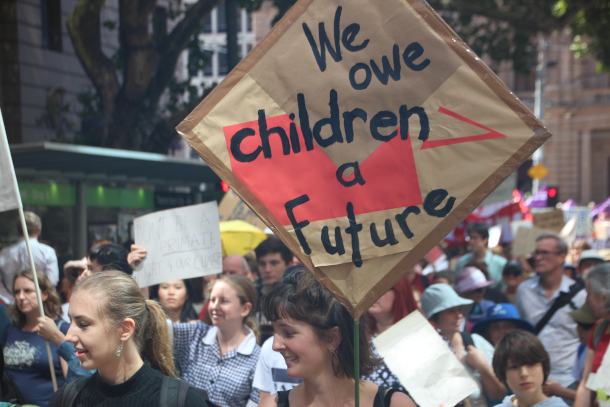
In The Carbon Wave: A Story of Democracy, Parenthood, and the Race to Save Our Planet, Leah Stokes writes that new parents should see their children, along with all the creatures on earth, as an extension of our responsibility to herald a healthy planet for the future, and inspire us all to take part in climate action and build a carbon wave in our communities. (Photo: Takver, Wikimedia Commons, CC BY-SA 2.0)
STOKES: Yeah. So in the climate movement, a lot of people were very angry at the moment that the bill text became public in late July 2022, and they tried to derail it because there were provisions that Manchin put in that many people did not agree with. I think that all bills are compromises. That's the reality. You know, none of us gets to be a dictator and say this is all of my ideas. Not even Trump has been able to do that, right? But I think if you take such a transformative law, it's like 20 times as much good stuff as bad stuff, and that can be hard to understand in the moment. So yeah, I also wrote about that conflict so that people reading the book who want to go and do activism or build a carbon wave aren't sort of blindsided by the fact that change is dramatic. You fight with your friends, you fight with your enemies, you fight with I don't know people you've never even met. It's hard to create change. My dad always says if you get up in the morning and you try to do something, you're gonna piss somebody off. This is what he always says to me, and that's the truth on some level that we can't shy away from what we believe to be the right direction, even if there's some compromise in the package.
DOERING: And I guess thinking about your carbon wave, you know, learning to surf that wave through the ups and downs, right?
STOKES: Yes, exactly, exactly.
DOERING: You know, it is hard to talk about climate policy these days without it acknowledging all the change in Washington that's happened since all of this went down-we're more than a year now into the second Trump administration and Republican control of Congress. When you think about what might have been had the Inflation Reduction Act not been mostly dismantled, what's the opportunity we lost?
STOKES: Yeah, so a lot of what Trump has done is not dismantling this law. It's dismantling regulations or creating new incentives for fossil fuels and blocking clean energy. The One Big Beautiful Bill Act, which passed last summer, did modify a lot of the law, but not actually the biggest parts of it. Had the One Big Beautiful Bill Act not passed, I think we would be on a much better trajectory for electric vehicles. For example, that's probably the thing that gets me the most bummed out right now. We are not having people buy electric vehicles at the pace that we need in the United States. In part because of what Elon Musk has been doing and how unpopular he is, in part because of the Trump administration's action to dismantle supports, electric vehicle sales have slowed. Now, they're not like reversing or negative or something like that. We're still deploying EVs. It's just that the pace is pretty relentless when it comes to the climate crisis. We kind of need everybody to, when they retire their fossil fuel car, replace it with an electric vehicle tomorrow.
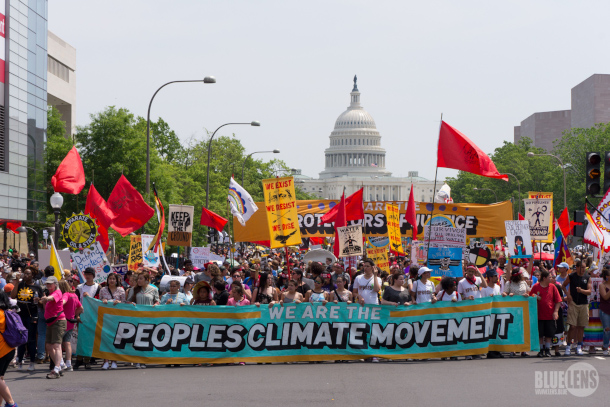
Leah Stokes describes a ‘carbon wave’ as ripples of movement and progress that are built when “thousands of people work together to create change, adding to the effort of the people before them.” (Photo: Mark Dixon, Wikimedia Commons, CC BY 2.0)
DOERING: So where are we now? Like, what is the good news side of the Inflation Reduction Act as it still stands, and where clean energy is in this country right now? What was the law able to accomplish and set in motion before some of it was repealed in 2025?
STOKES: Yeah, I think the brightest spots really have to do with two things: one, transforming our electricity system to be powered by clean energy, and two, the clean energy manufacturing buildout in this country. So, on the first thing, before the Inflation Reduction Act passed, in the years before, maybe about half of the new electricity that we were building in a given year would be clean. So that's things like wind or solar or batteries. After the Inflation Reduction Act passed, we're talking about north of 90% every year that is clean energy. Solar, batteries, I mean, they are just roaring ahead in this country, and it's everyday people too putting solar on their roof and getting a battery, and that's really looking good. And the tax credits for those technologies are largely still in place for the next couple years. So there's still support for building out solar and especially building out batteries. And the companies that develop these solar projects have found creative ways to make sure they can keep making progress in the coming years. So the largest tax credits in the Inflation Reduction Act were about building factories in the United States for solar panels and you know batteries and electric vehicles, and there are so many of these factories. It's kind of unfathomable. I think people don't understand how transformative this is. And you might think, "Oh well, now Trump's in power, so they must all be gone." No, we actually found that nine in 10 of those are still moving forward. That's going to really change the politics because now there will be good-paying manufacturing jobs in Republican districts all across the country. Now the bummer is that there were a lot of grants in the original Inflation Reduction Act law that were helping communities, for example, put a heat pump in a church or you know solar panels on on a roof. Those things all got pulled, but the good news is that they can be ready to go if and when there's another opportunity for action. And having those shovel-ready projects is often a barrier, you know, if you don't have them to making policy change. So, I think it's more of a delay than it is a reversal, if that makes sense.
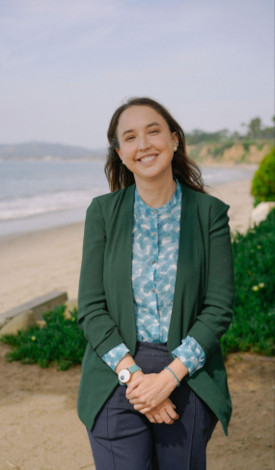
Leah Stokes is the author of The Carbon Wave; A Story of Democracy, Parenthood, and the Race To Save Our Planet (MIT Press, 2026) and Short Circuiting Policy: Interest Groups and the Battle Over Clean Energy and Climate Policy in the United States (Oxford University Press, 2020). She holds a PhD in Public Policy and currently teaches at the University of California, Santa Barbara. (Photo: Emmanuelle Pickett)
DOERING: Yeah, you were working on this bill while going through some incredibly difficult personal circumstances. You found out you were pregnant with twins, high-risk pregnancy at that. You watched the political setbacks begin to pile up. Tell me, how did you preserve your hope amid these challenges?
STOKES: So yeah, at the time that I was working on this bill, I was pregnant, and I discovered it was twins, and there was a lot of complications in my pregnancy. So essentially, one of my daughters was growth restricted, and so I didn't know if I would have two babies, one baby, or none. And so I tell that story alongside the bill because, in some ways, it was a very clear metaphor that we didn't know if the bill would pass or die or be mangled, you know, and not live in a way that was going to make the changes that we wanted to see in the world. And I think it's important too to say, when people read the book, they always want to know like, how are my daughters now? And like, they're great, much like the Inflation Reduction Act is still alive and well, so are my children. They're really smart and healthy and happy, and we're really lucky. So I just wanted to make the stakes of acting on climate really feel personal because they are personal. They affect all of our families and friends and neighbors and cousins and you know even non-human relations across the world. So I just wanted people to feel like this is such an important fight because it's really a fight for life on Earth, and all of us are part of that web.
DOERING: Leah Stokes' new book is The Carbon Wave: A Story of Democracy, Parenthood, and the Race to Protect Our Planet. Thank you so much, Leah.
STOKES: Thank you so much for having me on.
DOERING: And we’ll link to Leah’s Carbon Wave Calculator on the Living on Earth website, loe dot org.
Links
Check out the Carbon Wave Calculator
Follow along at Leah Stokes’ Substack
Purchase your copy of The Carbon Wave and support Living on Earth and independent booksellers
Living on Earth wants to hear from you!
Living on Earth
62 Calef Highway, Suite 212
Lee, NH 03861
Telephone: 617-287-4121
E-mail: comments@loe.org
Newsletter [Click here]
Donate to Living on Earth!
Living on Earth is an independent media program and relies entirely on contributions from listeners and institutions supporting public service. Please donate now to preserve an independent environmental voice.
NewsletterLiving on Earth offers a weekly delivery of the show's rundown to your mailbox. Sign up for our newsletter today!
 Sailors For The Sea: Be the change you want to sea.
 The Grantham Foundation for the Protection of the Environment: Committed to protecting and improving the health of the global environment.
 Contribute to Living on Earth and receive, as our gift to you, an archival print of one of Mark Seth Lender's extraordinary wildlife photographs. Follow the link to see Mark's current collection of photographs.
 Buy a signed copy of Mark Seth Lender's book Smeagull the Seagull & support Living on Earth
© Copyright World Media Foundation. All Rights Reserved
Home | Contact | RSS | Donate | Newsletter