

Community-Led Wildfire Prevention in Africa
Air Date: Week of April 24, 2026
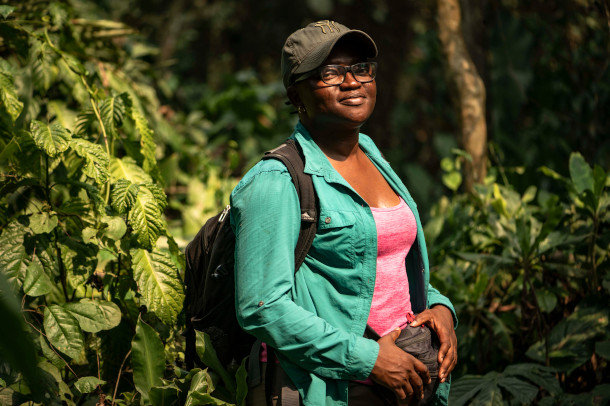
Iroro Tanshi is a Nigerian conservation ecologist and winner of the 2026 Goldman Environmental Prize for Africa. (Photo: Etinosa Yvonne for Goldman Environmental Prize)
Nigerian conservation ecologist Iroro Tanshi rediscovered the short-tailed roundleaf bat in 2016, after decades when it was believed extinct in the region. The species is still critically endangered, with habitat loss from wildfires as one of its top threats. So Iroro joined with local groups to start a community-led program to develop safer field burning practices and wildfire fighting strategies. Iroro Tanshi is the recipient of the 2026 Goldman Environmental Prize for Africa and talks with Host Jenni Doering.
Transcript
BELTRAN: It’s Living on Earth, I’m Paloma Beltran
DOERING: And I’m Jenni Doering.
Nigeria’s Afi Mountain Wildlife Sanctuary is home to many endangered species, like gorillas, rockfowl, and one tiny bat that was believed to be extinct in the region for nearly half a century. Wildlife ecologist Iroro Tanshi rediscovered the short-tailed roundleaf bat back in 2016, but the species is still critically endangered, with habitat loss as one of its top threats. So Iroro joined with local groups to start a community-led program to protect the forest, and her efforts have been recognized with a 2026 Goldman Environmental Prize for Africa. Iroro Tanshi joins me now – welcome to Living on Earth and congratulations!
TANSHI: Thank you very much. I'm very pleased to be here
DOERING: Iroro, when you spotted this roost of short-tailed roundleaf bats, it had been nearly five decades since they were last spotted in Nigeria. How did you feel in that moment?
TANSHI: It was just an absolutely incredible feeling, and because I was in the field by myself with local field assistants. It was kind of hard to translate it to them, so I basically said to them, our lives are about to change. Because they've been talking about how, you know, you have to come back and do more research. And I'll be like, well, I don't have money. I'm just a poor PhD student. But when we found that, I was like, our lives are about to change. We're about to come back to this forest, many, many, many, many times. And I'm actually very pleased to say we have now built a field station at that site, and we're going to keep studying bats and other cool species in that forest, because finding this rare bat just makes this a really, truly special place.
DOERING: Wow. And by the way, these tiny little guys, they're pretty darn cute. What do they look like?
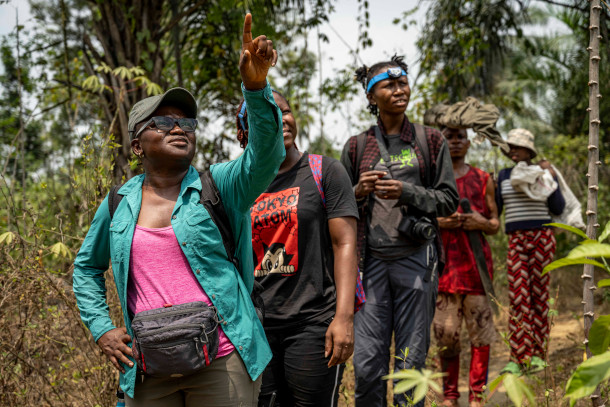
Iroro Tanshi (front) shows her team how to set bat traps in Odukpani, Cross River State, Nigeria. (Photo: Etinosa Yvonne for Goldman Environmental Prize)
TANSHI: That is one of my favorite questions. They look like a golf ball. So if you were going into a cave trying to look for them, they'd just be on a wall. They look like the size of a golf ball. But if they were to start flying, they would look like, you know, about 10 inches wing to wing. And they've got these sort of round point on their nose, so it's kind of like a button, you know, because bats are cuddly too. So if you fed them, they kind of become your friend, in a sense, for that short amount of time you have them. And so it almost feels like you could just, you know, poke them in the nose, you know, like, pop!
DOERING: Boop!
TANSHI: Boop, you know. So they're really cute like that, and they don't really like to be disturbed. So if you have a species that likes open spaces, you don't need to worry about that species. But if you have a species that doesn't like to be disturbed and needs protection for that matter, then what you're dealing with is a species that then saves other species, because that's what this bat's doing. We sort of started working to protect its habitat and, and that just meant we were saving habitat for the bat, but not only the bat, for lots of other species.
DOERING: Now, of course, when you rediscovered these endangered bats, the work didn't stop there. Tell us when your concern for these animals' safety became urgent.
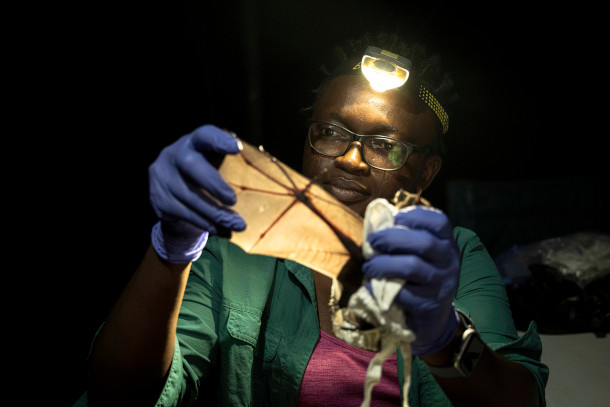
Iroro Tanshi holds up a short-tailed roundleaf bat for data collection. (Photo: Etinosa Yvonne for the Goldman Environmental Prize)
TANSHI: It was a rollercoaster that we experienced. One day we were celebrating the bat that we discovered. Eight days later, we were running for our lives from a wildfire that destroyed 50% of the bat's habitat.
DOERING: Oh, my.
TANSHI: So in terms of urgency, it was an instant moment, just realization that this is it. We gotta do something, you know? Okay, to be honest, when we ran from the forest fire, during that time of running from the forest fire with all of our bags and all of our gear and expensive equipment, my most important concern was to make sure everybody got to the village safe, because we were running down the mountain. It's not safe to be running down the mountain. But then as soon as we got back, when we looked back and took a photo of what the scene looked like, it was a huge conflagration. And in that moment, we knew, we've got to do something, but we thought it was going to be a small fire, you know, a couple of days. No, it burned for three weeks. Three weeks, you look on the map, and you're looking at 50% of the forest gone to fires.
DOERING: Gosh.
TANSHI: So it was an instant situation of just realizing that this is an urgent thing. It wasn't, it didn't take time, you know, we were like, we've got to act now, you know? So we started talking to community members. Initially, there was this sort of aah, no one's going to listen to you. But guess what? These guys, they also want to put out wildfires because it affects their farms too. There were people who were getting thrown into poverty because their whole farm has been burned, their whole family, their whole livelihood is gone. And so that urgency was that exact night when it happened, because we just discovered the species, and we were running for our lives and realizing this huge conflagration was just happening. If we didn't stop it, we won't be able to really speak confidently about any effort to save the species. And that will be a real shame to humanity, losing the species.
DOERING: So you mentioned, you know local people, they also wanted to help stop these wildfires. And fire had been used for a while, for a long time, for burning crops on the farms, but now it's like really getting out of control. What is going on now with fire in these communities and what has changed?
TANSHI: I like the word change. I like that you sort of landed on change, because when we started talking with local communities. They had all the answers. They were like, you know, we have a cultural way of burning, so it doesn't, you know, get out of hand. You know, we burn certain a time of the year. We burn at so and so time of the day, you know, early in the morning and stuff like that. They already had the data in their minds. It wasn't statistically written anywhere. It wasn't due to any kind of measurements that were taken but people had ideas about how to reduce wildfires and how to maintain their cropland with some fire, but safely and stuff like that. So responsible use of fires. But we kind of debated a lot of things during this almost three-hour session, and this elderly woman just stood up at one point and said, you know what all this talk is really because we don't really know the best time to burn anymore. We can no longer predict the best time to burn, if you could just tell us the best time to burn. And we thought, oh, that's interesting. Because without even knowing climate change, she basically said, in her lifetime, the weather patterns have changed. The rainfall patterns have changed. So without knowing climate change, she was describing climate change to us, and that was very touching to me, especially as a very young PhD student who didn't realize that local people have the answers, you know? So all we had to do was to say, beyond the big problem of the fire, how do you break down the different components of it? So they said to us, well, everything's all over the place. So we said, well, that's a problem that technology can fix. We can basically collect data from weather stations and predict when to burn. And that's because, you know, there are systems, especially here in the US, that would rely on weather data and tell people the best time to use a campfire, for example. That we immediately said to our people on the ground in the village and said, Look, we can use this system. And they got on top of it. In fact, it's now part of their local law that if the sign says this is a good day to burn, then that's fine. If it's not a good day to burn, you're not expected to burn, and indeed, you will pay a fine to the local community leadership. And that's kind of where it really all started. We just sort of took it away, was very much a co-managed system, co-designed system. And when I say 'co', I'm really exaggerating how much of an input we were making. We were really just providing a coordination support. They were telling us this is what we need. We need to be able to respond to fires when they happen effectively. Let me tell you how they used to respond to fires. They'll use branches, you know, cut a branch and beat the fire down, or, you know, run with a bucket from, you know, however far away that stream was. So it wasn't very effective. So they're trying to put our fires, they're trying to predict, but it's not quite working. So it was very much a coordination that we did, and they just basically set us up. And that I find to be an incredible story onto itself.
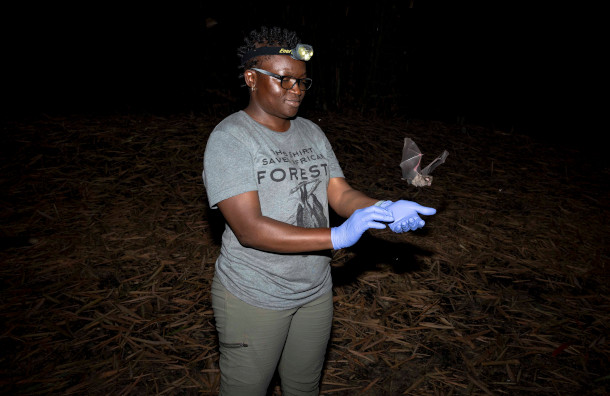
Iroro releasing a bat after data collection in Odukpani, Cross River State. (Photo: Etinosa Yvonne for the Goldman Environmental Prize)
DOERING: And so in addition to the tracking weather and the, I guess, the moisture content of the forest in real time and getting that information to the community, how else did you use technology to help these people prevent and fight wildfires?
TANSHI: Well, I gotta tell you, there's a there's a really nice manual technology. So technology is not always data driven, okay, it's not always like numbers. So there is a backpack that you can fill with water, five gallons, about 20 liters of water, and it's got a high-powered hose connected to it. And that high powered hose you can safely carry that up a mountain or across long distances on the ground in the farms and put out fires when they happen.
DOERING: Wow.
TANSHI: Because remember, these are systems where the water source is a river. Okay? So you have to travel, you know, long distances to get to it, depending on where it is. If you're lucky, you're right next to the river, that's fine. But in most cases, you're not close to a river. So that technology of having a backpack and a high-powered hose, that was an important technology on the response side of this whole system. There's something else that I have to point out, I'm sure your, your listeners will enjoy, is when we make our risk predictions, we let the local people know, and the chief forest guardian will put that sign up on the sign post. But there's also another communication mechanism we use, just in case. You know, they're not able to either go to the sign today. Maybe their farm is in one direction, but the sign is in the other direction. Local communities in this area, in Cross River in Nigeria, they have what's called a town crier, so someone who goes around in the morning, you know, very early in the morning, just before it's bright, at dawn, and they hit a gong very loudly, and they basically, kind of almost wake you up. So if you're in a village at that time, at 6am, you hear a very loud gong that says, you know, hello, hello, everybody. This is a red fire day. Do not use fires on your farm. That is human technology, right there, you know? So when we say technology, some of it's data driven, some of it is just reapplication of, you know, existing tools, as it were, and it always makes a difference, because it's really about solving that problem at a small level, and it builds up to solving this big problem of making sure that fires do not progress from farms to forests.
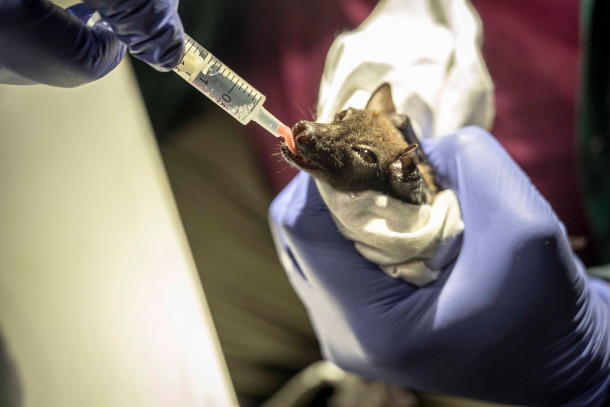
Iroro feeds an Angolan soft-furred bat with a dropper. (Photo: Etinosa Yvonne for the Goldman Environmental Prize)
DOERING: It sounds like the town crier, you know the "hear ye, hear ye", that we've heard about.
TANSHI: Hear ye, yes!
DOERING: And that is technology that works in the local community. That's a human societal technology that is appropriate for a village.
TANSHI: Exactly! A village that does not have cell service.
DOERING: Mmhmm.
TANSHI: Yes, if people don't have cell service, and in fact, you wouldn't believe this, but because it's a mountain range, well, I guess you would, because you're a radio program, you would understand radio waves bounce around a lot in this sort of mountain landscape. So using radio can be quite tricky. And in fact, some of the radio that comes from the city doesn't always get here because they are cut off. So if you're generating radio, it has to be, you know, on the ground there. So in any case, the most effective technique is what the community is already using. And we just got in there and said, well, let's get the town criers to speak. And in fact, it was one of the community people who said, well, we have to get the town criers to tell people. I was like, yeah, I agree, completely.
DOERING: So how successful has this zero-wildfire campaign been and what's the current status of the Afi Mountain Wildlife Sanctuary?
TANSHI: Oh, that's such a great question, because I've got news.
DOERING: Wonderful!
TANSHI: We just closed fire season at Afi Mountain this year, and it's the fifth year in a row when we've had zero wildfires in the forest - zero.
DOERING: Amazing.
TANSHI: That is down from annual fires of, say, five to maybe 30 fires happening in a year in the park. But for the past five years, it's been down to zero, and we've been jubilating. Our teams have been, you know, just excited and everyone's happy in the village. You know, it's like we're all really just pleased to not have to deal with wildfires. So the whole program has suddenly saved Afi Mountain Wildlife Sanctuary from fires. And you can look at the map, you go from 2016 and you know multiple years before that, lots and lots of fire counts within the park to a park where it's completely zero. So the map, we've got this slide show where we show how the fires have sort of dwindled across the years. And it's incredible. It's just incredible. We're really proud of it.
DOERING: And of course, that's good for the people and their farms and homes, and good for the bats.
TANSHI: Absolutely, absolutely. It's great for bats. We're finding more and more individuals of our species, primarily when you're trapping in the forest, but we're also seeing more bat species at this site as well.
DOERING: So Iroro, what do you hope is the future of this system that you've helped to create, and what do you want people to learn from your success?
TANSHI: Oh, I like that so much. First of all, I want to say it's been an incredible effort. You know, across work from our team members, our government partners, our community partners, you know, the community leaders who enforce the law, without any input from us, we just ask them, did you enforce it? Yes? Okay, good. All of those people, this has been the effort of so many people. So I'm really, truly grateful for that, that we sort of created a movement on the ground around one protected area. We started another protected area in Nigeria, so protecting two places from wildfires now. Now on top of that, because we've seen how successful this has been and we've talked with colleagues across Africa, in fact, some places in Southeast Asia, we've got colleagues who would like to test this at our site. And we're like, well, we've got the answers. So we're actually just now launching a program that is pantropical, and it will help people to adopt parts of this program that we've been successful with on their own forest patches around the world. So we're taking this thing global, is what I'm trying to say. So I'm really, I'm incredibly proud of what we've done. I'm incredibly grateful for all the people who've supported us at this point. It's just been an incredible movement. And I want people to get the point that on the one hand, one or two people can make a difference if you push for it, but also local people, especially forest people, they are the custodians. They're the people you want to be talking to. They're the ones who have the solutions. They may not know the exact terms in the modern technology world that we live in today. But come on, you can always translate whatever they say. If they say, we can no longer predict, that's what the problem is. If they say, we just need to know when to burn, that's what the solution is. You know, you've got to go translate that solution to whatever new ways the modern world interprets these things. So it's just incredible that we've been able to do this. And we want people to see that they too in their own ways and their own community can make a difference. Just find your community. Find your village to support you, but find the community people who will take that action with you and just take it away, because the world needs people like that who have a fire in the belly. In our case, our fire was started by fire. There you go. You know who just take it away and rest assured that people will work with you.

Iroro Tanshi at the Goldman Environmental Prize award ceremony. (Photo: Goldman Environmental Prize)
DOERING: Iroro Tanshi is the winner of the 2026 Goldman Environmental Prize for Africa. Thank you so much for joining me, Iroro. It's been a real pleasure.
TANSHI: Thank you. I really enjoyed this conversation.
Links
Iroro Tanshi’s profile at The Goldman Environmental Prize
The Goldman Environmental Prize
Learn more about the short-tailed roundleaf bat on Wikipedia
Living on Earth wants to hear from you!
Living on Earth
62 Calef Highway, Suite 212
Lee, NH 03861
Telephone: 617-287-4121
E-mail: comments@loe.org
Newsletter [Click here]
Donate to Living on Earth!
Living on Earth is an independent media program and relies entirely on contributions from listeners and institutions supporting public service. Please donate now to preserve an independent environmental voice.
NewsletterLiving on Earth offers a weekly delivery of the show's rundown to your mailbox. Sign up for our newsletter today!
 Sailors For The Sea: Be the change you want to sea.
 The Grantham Foundation for the Protection of the Environment: Committed to protecting and improving the health of the global environment.
 Contribute to Living on Earth and receive, as our gift to you, an archival print of one of Mark Seth Lender's extraordinary wildlife photographs. Follow the link to see Mark's current collection of photographs.
 Buy a signed copy of Mark Seth Lender's book Smeagull the Seagull & support Living on Earth
© Copyright World Media Foundation. All Rights Reserved
Home | Contact | RSS | Donate | Newsletter