

Ocean Monitoring Restored
Air Date: Week of June 26, 2026
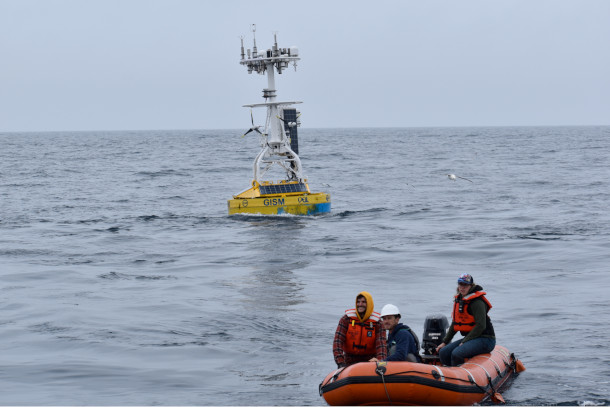
Shown above is a surface buoy in the Irminger Sea, off the coast of Greenland, as the Irminger 8 team heads out to inspect it. Buoys like this contribute to the 900 or so instruments that are part of the Ocean Observatories Initiative. (Photo: Image from work supported by the U.S. National Science Foundation Ocean Observatories Initiative, oceanobservatories.org)
After announcing at the end of May it was dismantling the Ocean Observatories Initiative, the National Science Foundation faced widespread public criticism and the Senate passed a bipartisan measure to preserve the vital ocean monitoring network. NSF then reversed its decision and says an array that was already being removed will be redeployed. Living on Earth’s Aynsley O’Neill joins Hosts Steve Curwood and Jenni Doering to discuss this reprieve for climate and ocean science.
Transcript
CURWOOD: From PRX and the Jennifer and Ted Stanley Studios at the University of Massachusetts Boston, this is Living on Earth. I’m Steve Curwood.
DOERING: And I’m Jenni Doering.
At the end of May, the National Science Foundation announced it was dismantling the Ocean Observatories Initiative. For more than a decade this project has used roughly 900 instruments on the Atlantic and Pacific oceans to measure currents, temperature, carbon dioxide levels, and more.
CURWOOD: But in the face of widespread public criticism, the NSF recently reversed its decision, saying it would keep keeping tabs on the oceans after all. For more on this, we turn now to Aynsley O’Neill, who’s been following this story for Living on Earth. Hey there!
O’NEILL: Hi Steve, hi Jenni.
DOERING: So, Aynsley, please remind us of what makes Ocean Observatories Initiative so important?
O’NEILL: Well, you mentioned some of the data gathered by the program, that’s used by scientists studying the ocean, but it also helps inform industries like weather forecasting, insurance, and especially fisheries.
CURWOOD: Well, Aynsley, so why get rid of it?
O’NEILL: The NSF said it was a move to improve efficiency, but there was widespread sentiment in both the science and political communities that it was part of efforts by the Trump Administration to limit science on climate change, especially when ocean currents and chemistry can tell us a lot about warming.
CURWOOD: That’s right, Aynsley. I recall our guest at the time the Ocean Observatories Initiative was on the chopping block, a former NOAA official, linked it to NSF’s attempts to shut down NCAR, the National Center for Atmospheric Research. That’s now before the courts, so why did the oceans program get reinstated before any litigation?

Senator Lisa Murkowski (R-AK) is part of the Senate Oceans Caucus. She is the lead sponsor on the Saving the OOI Act of 2026. (Photo: Committee on Energy and Natural Resources)
O’NEILL: So, there was a massive professional and public outcry, from both scientists and politicians alike. And that led to a rare bipartisan bill to save OOI endorsed by both Republican senators from Alaska, that's Lisa Murkowski and Dan Sullivan, Oregon Democrat Jeff Merkley, and several other Senate Democrats. And end in the end, it passed the senate by a voice vote.
CURWOOD: So, Aynsley, a voice vote with no record made means John Thune, the senate majority leader from South Dakota, must have allowed it. I imagine he’s trying to shield any other Republicans wanting to keep the program from criticism from the Trump White House?
O’NEILL: Well, I didn't quite hear that from any of the guests that I spoke to, but it makes sense, with a voice vote, I think that means that the only Republican senators on record as supporting this would be those two Alaskans, and I mentioned fisheries before, those are obviously huge in the state.
DOERING: Yeah. And there is a senate race this year in Alaska. This is for Republican senator Dan Sullivan. He is behind in polls compared to his Democratic challenger, Mary Peltola.

Senator Dan Sullivan (R-AK) is the other Republican co-sponsor of the Saving the OOI Act of 2026. He is running for reelection in the 2026 midterm elections. (Photo: United States Senate, Wikimedia Commons, public domain)
O’NEILL: And one other thing that I heard was that Peltola is really looking to focus on fisheries, so it sounds like Sullivan wouldn't want to give her any points on that. And then of course it would also help John Thune’s quest to hold the majority if Sullivan keeps his seat.
CURWOOD: So, back to the Ocean Observatories Initiative itself, how much of it was dismantled between the original announcement and the NSF walking it back?
O’NEILL: From what I heard, it sounds like the Endurance Array off the coast of Oregon and Washington state was the one aspect which was already in process of being removed from the water. But in a statement, the NSF says that they’re “developing plans to redeploy the equipment after servicing.”
CURWOOD: Well, we’ll want to keep an eye on that and the Alaska senate race as they move forward. Thanks for bringing this to us, Aynsley.
O’NEILL: Thanks, Steve, thanks, Jenni!
DOERING: Yes, thank you.
CURWOOD: That’s Living on Earth’s Aynsley O’Neill.
Links
Read the National Science Foundation’s announcement to maintain the Ocean Observatories Initiative
Grist | “Outrage Rescued an Important Ocean Research Program. Crucial Ones Remain at Risk.”
Living on Earth wants to hear from you!
Living on Earth
62 Calef Highway, Suite 212
Lee, NH 03861
Telephone: 617-287-4121
E-mail: comments@loe.org
Newsletter [Click here]
Donate to Living on Earth!
Living on Earth is an independent media program and relies entirely on contributions from listeners and institutions supporting public service. Please donate now to preserve an independent environmental voice.
NewsletterLiving on Earth offers a weekly delivery of the show's rundown to your mailbox. Sign up for our newsletter today!
 Sailors For The Sea: Be the change you want to sea.
 The Grantham Foundation for the Protection of the Environment: Committed to protecting and improving the health of the global environment.
 Contribute to Living on Earth and receive, as our gift to you, an archival print of one of Mark Seth Lender's extraordinary wildlife photographs. Follow the link to see Mark's current collection of photographs.
 Buy a signed copy of Mark Seth Lender's book Smeagull the Seagull & support Living on Earth
© Copyright World Media Foundation. All Rights Reserved
Home | Contact | RSS | Donate | Newsletter